 |
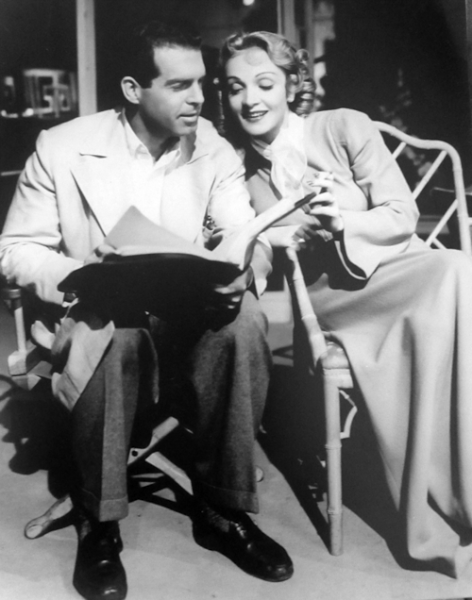
| Totally unrelated. Fred MacMurray & Marlene Dietrich on the set of The Lady is Willing.;) |

Showing posts with label 1990s. Show all posts
Showing posts with label 1990s. Show all posts
09 April 2015
The Testatrix Is Willing


12 November 2012
Dietrich Apocrypha: Eryk Hanut's I Wish You Love
The second blog entry in a series about Marlene Dietrich biographies that have not joined Maria Riva and Steven Bach's books in the Dietrich canon.
When I began writing this entry, my opening line was, "Like any genre, biographies tend to be cannibalistic." What hogwash! Those who have written biographical accounts about Marlene Dietrich may have often referenced each other, but I can't deny that they presented untapped sources that always stop me from throwing out their biographical babies with the bathwater. For example, Donald Spoto impressively managed to quote the then-unpublished memoirs of Marlene's acting school pal, Grete Mosheim, in his book, whereas the great Steven Bach merely cited Charles Higham's brief account about the two Berthold Held neophytes.
Rather than generalize all biographies, I should have only called Eryk Hanut's I Wish You Love: Conversations With Marlene Dietrich cannibalistic. It's as if he inverted the narrative of Goya's Saturn by devouring every available biographical account on Dietrich, regurgitating his readings to her, and eventually compiling her reactions in his own biographical account. Pardon me if that sounds unkind because I do in fact appreciate this book as a series of somewhat Socratic dialogues between Dietrich and Hanut. The questions that Hanut poses aren't the insipid fare. There's no "What was Hollywood like?" Well, almost nothing like that. Hanut does admit to asking, "What was it like, the war?" To which Marlene responds, "You are being really stupid" (p. 84). Usually, though, Hanut asks questions such as, "Who are your favorite painters, Marlene?" (p. 70). If you were the least bit cynical, you would probably suspect that Marlene's answer--Cézanne--came from her memoirs rather than any conversation that Hanut had with Dietrich. Who really knows?
I will be unambiguously skeptical about a few details, though, after reading a comment recently made by the inimitable Sauli Miettinen. Hanut recalls seeing Marlene perform in Paris when he was 8 years old. We later learn that Hanut was born in 1967. Let's do the math. 1967 plus 8 makes 1975. I, however, see no indication that Marlene performed in Paris during that year. We could give Hanut the benefit of the doubt because remembering one's childhood in terms of places and dates can be hazy. Perhaps he saw her when he was even younger or somewhere else altogether. I at least found evidence indicating that Hanut contributed to an exhibition of Marlene Dietrich photos, but in Charleroi rather than Brussels.
When I began writing this entry, my opening line was, "Like any genre, biographies tend to be cannibalistic." What hogwash! Those who have written biographical accounts about Marlene Dietrich may have often referenced each other, but I can't deny that they presented untapped sources that always stop me from throwing out their biographical babies with the bathwater. For example, Donald Spoto impressively managed to quote the then-unpublished memoirs of Marlene's acting school pal, Grete Mosheim, in his book, whereas the great Steven Bach merely cited Charles Higham's brief account about the two Berthold Held neophytes.
Rather than generalize all biographies, I should have only called Eryk Hanut's I Wish You Love: Conversations With Marlene Dietrich cannibalistic. It's as if he inverted the narrative of Goya's Saturn by devouring every available biographical account on Dietrich, regurgitating his readings to her, and eventually compiling her reactions in his own biographical account. Pardon me if that sounds unkind because I do in fact appreciate this book as a series of somewhat Socratic dialogues between Dietrich and Hanut. The questions that Hanut poses aren't the insipid fare. There's no "What was Hollywood like?" Well, almost nothing like that. Hanut does admit to asking, "What was it like, the war?" To which Marlene responds, "You are being really stupid" (p. 84). Usually, though, Hanut asks questions such as, "Who are your favorite painters, Marlene?" (p. 70). If you were the least bit cynical, you would probably suspect that Marlene's answer--Cézanne--came from her memoirs rather than any conversation that Hanut had with Dietrich. Who really knows?
I will be unambiguously skeptical about a few details, though, after reading a comment recently made by the inimitable Sauli Miettinen. Hanut recalls seeing Marlene perform in Paris when he was 8 years old. We later learn that Hanut was born in 1967. Let's do the math. 1967 plus 8 makes 1975. I, however, see no indication that Marlene performed in Paris during that year. We could give Hanut the benefit of the doubt because remembering one's childhood in terms of places and dates can be hazy. Perhaps he saw her when he was even younger or somewhere else altogether. I at least found evidence indicating that Hanut contributed to an exhibition of Marlene Dietrich photos, but in Charleroi rather than Brussels.
08 August 2012
When Baryshnikov & Dietrich Met on Business
Back in 1987, the Council of Fashion Designers of America (CFDA) hosted its 6th annual awards dinner at the Temple of Dendur in the Metropolitan Museum of Art. For $750 a plate, attendees got to watch designers--who paid only $250 for their grub (beat that, AARP cardholders!)--walk like Egyptians to the podium and bask in the recognition of their peers.
Absent from the ceremony was Marlene Dietrich, who had won a lifetime achievement award, which someone less respectful than I might term a sort of "deathbed award" that Dietrich describes under her ABC entry, "Academy Award." On Marlene's behalf, Mikhail Baryshnikov accepted the award. Maria Riva tells us in her book that Dietrich rejected David Riva for this task in favor of the diminutive dancer-turned-actor, who became the object of her mother's unbridled octogenarian lust.
If Baryshnikov never had the chance to visit Dietrich's "nice and tight" nether regions, at least one of her top-shelf impersonators, played by Adele Anderson, flirted with him and Gene Hackman in the 1991 movie, Company Business. This Dietrich may be dressed like The Blue Angel's Lola-Lola, but she's singing "The Boys in the Backroom," the signature song of Destry Rides Again's Frenchy, even jiggling her Adam's apple like the saloon strumpet to whimper with vibrato!
Absent from the ceremony was Marlene Dietrich, who had won a lifetime achievement award, which someone less respectful than I might term a sort of "deathbed award" that Dietrich describes under her ABC entry, "Academy Award." On Marlene's behalf, Mikhail Baryshnikov accepted the award. Maria Riva tells us in her book that Dietrich rejected David Riva for this task in favor of the diminutive dancer-turned-actor, who became the object of her mother's unbridled octogenarian lust.
If Baryshnikov never had the chance to visit Dietrich's "nice and tight" nether regions, at least one of her top-shelf impersonators, played by Adele Anderson, flirted with him and Gene Hackman in the 1991 movie, Company Business. This Dietrich may be dressed like The Blue Angel's Lola-Lola, but she's singing "The Boys in the Backroom," the signature song of Destry Rides Again's Frenchy, even jiggling her Adam's apple like the saloon strumpet to whimper with vibrato!
24 April 2011
1997 Mercedez-Benz Commercial
I have read some biting criticism about the 1997 Mercedes-Benz commercial that interpolated Marlene Dietrich's "Falling In Love Again" in the style of the Natalie and Nat King Cole duet "Unforgettable," but the obvious reasons for the song's use were its theme of desirability, its nostalgic appeal, and the Teutonic elegance that the Dietrich and Mercedes-Benz brands exude. The formula worked because in 2005 Car and Driver magazine rated the commercial the third best car commercial of all time.
This version of the commercial clocks in at just over a minute:
This version is the standard 30 seconds and apparently appears at the beginning of The Lost World: Jurassic Park VHS tapes:
This version of the commercial clocks in at just over a minute:
This version is the standard 30 seconds and apparently appears at the beginning of The Lost World: Jurassic Park VHS tapes:
Subscribe to:
Posts (Atom)