Pages

Showing posts with label 1940s. Show all posts

27 December 2020

Did Marlene Dietrich participate in the Nuremberg War Crimes Trial 75 years ago?


We're pleased to share this contribution from Horst Zumkley. You can also read it in German at Werner Sudendorf's Alte Filme site

I. The first trial before the International Military Tribunal against the main war criminals of the Nazi regime was held in Nuremberg 75 years ago, from November 20, 1945 to October 1, 1946. The trial, which made legal history, was a major media event from the outset, with some 250 accredited newspaper and radio reporters from around the world [1].


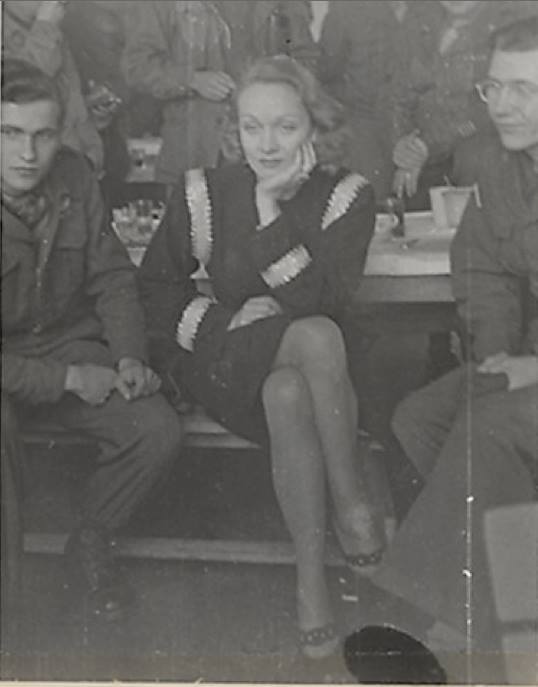
The author Eva Gesine Baur writes in her biography of Marlene Dietrich that Dietrich took part in the Nuremberg Trial on November 27, 1945; the idea of a visit there was suggested to her by Billy Wilder (Baur, 2017, p. 311). Dietrich had been sitting on the guest balcony in American uniform and in the evening she had been smiling and signing autographs in a pompous bar, surrounded by a swarm of people (p. 312).


Six months later, in his double biography about Dietrich and her sister Liesel, Heinrich Thies also writes that in 1945 Dietrich "witnessed for a few hours how things actually happened at the Nuremberg Trials. The Americans had secretly provided her with a seat in the visitors' gallery" (Thies, 2017, p. 303). As source for this he cites the Baur book (Thies, 2017, p. 405).


If this was true, it would be real and not unimportant news in the biography of Marlene Dietrich, which has remained completely unknown so far. 


Except for the Baur biography, I was not aware of any references, reports, testimonies or evidence that mentioned, confirmed, or substantiated this trial visit: Neither in the Dietrich’s autobiography nor in her many interviews, neither in the the Dietrich biography by her daughter Maria Riva nor in the book and documentary by her grandson J.David Riva is there anything about it. And there is no mention of it in the many Dietrich biographies (e.g., by Bach, Higham, Spoto, Sudendorf, Walker); nor in the exhibition catalogue of the "Memorial Hall Oberhausen" (2016), which documents Dietrich's resistance activities against the Nazi regime.


Therefore, the question arises: Can this be true? Because the Baur book is a "fictionalized" biography in which source-related facts are freely supplemented and combined into a new, novel-like whole [2]. One wonders: Is Dietrich's trial visit in November 1945 a fact or a novelistic invention? On what evidence or "sources" does Eva Gesine Baur base her report? And can the true facts of the case be clarified? Is there any reliable evidence?


II. The only source Baur refers to is a book by Boris N. Polewoi, who was then accredited as Pravda correspondent at the 1st Nuremberg Trial [1]. His "Nuremberg Diary" was published in 1971 as a translation from Russian in the former GDR. However, his book is not a diary in the usual sense, but he has "now, more than 20 years after the trial...literally edited the records of that time, trying to preserve the spirit of those days and my view of things at that time" (p. 6). The whole text is written like a novel (and is advertised as a book as well), without any precise or anchoring data of that time.


What Polewoi (1971) writes about the Dietrich visit at the Nuremberg Trial is spread over several pages in short sections. There it says [in English translation]:


"I arrived on the sixth day of the trial [3] and I realized already in the car that I had missed a lot. More than three hundred reporters, photographers, film people and press artists had come from all corners of the world. (p. 13).

"The colonel ... led us to the guest corridor where an honorable audience crowded in. He let me take a seat next to a very pretty, not quite young woman, who wore an American uniform and somehow looked familiar to me" (p. 15).

"My beautiful neighbor asked me something in English, and her melodious voice immediately brought me back...to the large hall lined with oak and green stone. She did not understand my silence, asked again, and I answered with the only sentence I knew in English: “I don't speak English" (p. 17).

At lunchtime, Polewoi and friends "went to the pompous bar, sparkling with marble and chrome, where gorgeous, long-legged girls, as it were emerging from the front pages of New York magazines, served the guests coffee, juice or Coca Cola, this, it seemed, obligatory attribute of the American way of life.

By the way, I rediscovered my neighbour in the bar, who was surrounded by a swarm of people. Smiling, she handed out autographs, in notebooks, on business cards and even on playing cards.

"Who is she?" I asked the photojournalist of Pravda, Viktor Tjomin. "Ignorant," he scornfully threw down, "and in gala uniform to boot! That is Marlene Dietrich herself!"

As the trial went on, I took my seat in the front row again, next to my famous neighbour. Without taking off her headphones she looked tiredly into the hall. Then she pulled a tin of sweets out of her purse, put one in her mouth and held another one out to me. I took the candy and politely spoke my second English sentence, which I had already learned in Nuremberg: "Thank you." It may have sounded rather funny, like "thank cow", but I was glad that I didn't embarrass myself worse in front of the famous actress" (p. 20).


What's a person to think? Polewoi meets a (bonbon-sucking) woman in uniform in the visitors' gallery of the courtroom, whom he doesn't know, who signs autographs in a bar during the lunch break [for Baur it's "in the evening"] and whose name is then given to him by a colleague: "Marlene Dietrich". 

Is this really serious, or is it rather a joke that his colleague Tjomin has allowed himself to make? 

Or maybe just a fruit of his "literary adaptation" 20 years later, shortly after the film "Judgement at Nuremberg" was released?


III. Dietrich was well known for her films and her involvement in the war, and it is unlikely that her appearance at the trial would have been hidden from the hundreds of journalists and the many prominent writers [1] who reported from there. But there were no reports about it at the time.


One of these journalists accredited at the time was Markus Wolf [4], who later became head of the GDR's foreign secret service. He was the only German correspondent (of “Berlin Radio” of the Soviet Occupation Zone) allowed to report  from the first day of the trial (Krösche, 2009, p. 59). Wolf (2006) contributed to J. David Riva's book on Dietrich’s activities during World War II. In it he extensively honors among other things the "anti-fascist resistance" (p.100) of Dietrich during the war. And he also praises her role in the film "Judgement at Nuremberg". He recalls that he himself experienced practically the entire Nuremberg Trial and that Stanley Kramer's film captured the atmosphere of the trial very authentically. If the journalist Wolf had known of a visit of Dietrich at the trial at that time, he would certainly have mentioned this in his book contribution here.


IV. Inquiries were made to two institutions that had original documents from the time, whether there was any evidence of a visit by Dietrich to the Nuremberg Trial: A) At the "Memorium Nuremberg Trials" in Nuremberg [5] and (B) at the "Marlene Dietrich Collection Berlin" (MDCB) [6].


A) Request at the "Memorium": Although the Nuremberg Trial was public, the access of the participants was strictly regulated and was precisely recorded (cf. Krösche, 2009). Polewoi also writes of "American military police officers who checked the admission tickets" (1971, p. 19). It is hard to believe that Dietrich could simply walk into the courtroom. So the question arises whether the name "Marlene Dietrich" appears on an accreditation or visitor list.

The research inquiry at the museum "Memorium", whether a visit of Dietrich on that day is known and on record, resulted in the following answer:


"In any case, she is not on the accreditation list compiled by the Americans and she would have got there through the US delegation. And she probably would have been on the list at that early stage. It is at most possible that she could have been there as a spectator on that day. Perhaps as part of a visit to the troop care centre. Unfortunately, I cannot say anything about that" (Fischer, 2020).


This means that there is no evidence of a visit by Dietrich on that day in the original trial documents.


Concerning a possible visit of Dietrich on November 27, 1945 in Nuremberg in the context of the troop support of the USO Camp Shows (United Service Organizations), this can be excluded, as can be seen on the USO homepage:


“Marlene Dietrich was also a familiar face on the Foxhole Circuit in Europe, making two USO tours there during the war. According to the Library of Congress, ‘The first was to North Africa and Italy, where she became the first entertainer to reach rescued soldiers at Anzio. During her second tour [after D-Day], lasting 11 months, she entertained near the front in France and Germany’” [7].


Because D-Day (the beginning of the landing of Allied troops in Normandy) was June 6, 1944, this means that in November 1945, her second USO tour had ended months earlier. Sudendorf (2001, p. 137) dates her second USO tour from September 1944 to July 1945.


B) Request to the "MDCB: In 1993 the State of Berlin took over the estate of Marlene Dietrich. The extensive holdings of this personal archive of the “Deutsche Kinemathek” document almost completely the biography of the actress and singer. The inquiry there concerning the trial visit of Dietrich in Nuremberg resulted in the following answer:


"According to the material in the estate and to my knowledge, there is nothing that supports or proves the claim of the visit to the Nuremberg Trials.

In November 1945, Marlene Dietrich was first in Paris. On November 4 she learned that her mother had died the day before. She was not able to reach Berlin until November 9; in addition to the formalities, there was hardly any or no flying for several days due to very heavy fog.

After the "night and fog" burial of her mother, Marlene is said to have left for Paris again. There is no proof of this; it seems plausible, especially since Jean Gabin was also in Paris.

If she had travelled to Nuremberg again in November '45 (she was there with the US troops for a few days in April/May 1945), there would certainly have been a corresponding indication somewhere. But neither in the letters to Rudi Sieber, nor in his diary there are any such indications. She herself never referred to it; not even when she talked to Maximilian Schell again much later about the film "Judgement at Nuremberg ". She would certainly have mentioned it, if not even pointed it out, if she had been there herself.

On what occasion? Private, at her own request? At that time it was not possible to get from A to B without further ado. There is no pass or any other document that refers to it. Nor is there any indication that she might have gone there accompanied by others. As far as I know, none of the prominent rapporteurs (Kästner, Hemingway, Erika Mann, John Dos Passos, etc.) has ever mentioned in passing that Marlene had been there. Of course, the rapporteurs did not focus on who else was "seen" there.

The only source seems to be this "Nuremberg Diary", written by a front reporter of the Pravda - who did not recognize the woman herself and who learns from a Pravda colleague of all people that it is Marlene Dietrich.

So there is hardly anything in favour, but a lot against it. On the basis of the facts, however, it cannot be completely ruled out"(Ronneburg, 2018).


Conclusion: As a result of these explanations, the question asked at the beginning must probably be answered with "no". According to the current state of affairs, there are no reliable indications or facts that prove that Marlene Dietrich visited the Nuremberg War Crimes Trial 75 years ago (unless new evidence has surfaced).

The only proven connection to the Nuremberg trial is probably Marlene Dietrich's appearance in the film "Judgement at Nuremberg". The world premiere of the film took place in the Berlin Congress Hall on December 14, 1961.


Literature:

     Baur, Eva Gesine (2017). Einsame Klasse - Das Leben der Marlene Dietrich.       München: Verlag C. H. Beck. 

     Fischer, A. (2020). E-Mail vom 02.06.2020 von Axel Fischer, Memorium Nürnberger Prozesse, Nürnberg.

     Gedenkhalle Oberhausen (Hrsg.).(2016). Marlene Dietrich. Die Diva. Ihre Haltung. Und die Nazis. Oberhausen: Verlag Karl Maria Laufen. [Katalogbuch zur Ausstellung in der Gedenkhalle Oberhausen vom 12.6.2016 bis 11.12.2016].

     Krösche, Heike (2009). Zwischen Vergangenheitsdiskurs und Wiederaufbau. Die Reaktion der deutschen Öffentlichkeit auf den Nürnberger Prozess gegen die Hauptkriegsverbrecher 1945/46, den Ulmer Einsatzgruppenprozess und den Sommer-Prozess 1958. Phil. Diss., Universität Oldenburg [http://oops.uni-oldenburg.de/1913/1/krozwi09.pdf]. 

     Polewoi, Boris (1971). Nürnberger Tagebuch. Berlin: Verlag Volk und Welt.

     Riva, J. David (Ed.) (2006). A woman at war: Marlene Dietrich Remembered (Painted Turtle Books). Wayne St. Univ. Press.

     Ronneburg, S. (2018). E-Mail vom 18.04.2018 von Silke Ronneburg, MDCB der Deutschen Kinemathek, Berlin. 

     Sudendorf, W. (2001). Marlene Dietrich. München: Deutscher Taschenbuch Verlag.

     Thies, Heinrich (2017). Fesche Lola, brave Liesel. Marlene Dietrich und ihre verleugnete Schwester. Hamburg: Hoffmann und Campe. 

     Wolf, M. (2006). Chapter pp. 95-101. In: Riva, J. David (Ed.) (2006). A woman at war: Marlene Dietrich Remembered (Painted Turtle Books). Wayne St. Univ. Press.


Notes:

[1]https://de.wikipedia.org/wiki/N%C3%BCrnberger_Prozess_gegen_die_Hauptkriegsverbrecher  

[2] http://lastgoddess.blogspot.com/2017/07/einsame-klasse-by-eva-gesine-baur-review.html

[3] Aus der Angabe „sechster Prozesstag“ rekonstruierte Baur das genaue Datum, den 27.11.1945 / Baur reconstructed the exact date from the information "sixth process day“:

http://www.zeno.org/Geschichte/M/Der+N%C3%BCrnberger+Proze%C3%9F/Hauptverhandlungen

[4] https://de.wikipedia.org/wiki/Markus_Wolf 

[5] https://museen.nuernberg.de/memorium-nuernberger-prozesse/

[6] https://www.deutsche-kinemathek.de/de/sammlungen-archive/sammlung-digital/marlene-dietrich-collection-berlin

[7] https://www.uso.org/stories/2368-uso-camp-shows-d-day-and-entertaining-troops-on-the-european-front-lines-in-wwii


25 April 2016

Marlene Dietrich, University Lecturer?

Marlene Dietrich, Hotel Carlton, Biarritz, 1945?
If a Welsh warrior can metamorphose into a demigod king with a Round Table and an Excalibur, what could a Prussian girl from a good military family one day become? Much of Marlene Dietrich's life isn't yet a century old, yet research and memories about even the briefest of its interludes can muddle what must have once been solid facts into a slurry of legends. One of these moments in Dietrich's life includes her time at Biarritz during the tail end of 1945, where she was--perhaps--a university lecturer?

During 1945 and 1946, the Biarritz American University (BAU) educated G.I.s not in traditional classrooms but in the seaside resort town's hotels and villas, a much deserved respite to help these troops reintegrate into civilian life after having survived World War II. As if the luxurious locale wasn't enough, stars such as Dietrich reportedly made appearances at BAU to lecture and perform, leaving indelible impressions on the war hero students that sometimes veered toward the outrageous.

10 March 2015

The "Russian Soul" in Marlene Dietrich’s Flicks


This post is part of the Russia in Classic Film Blogathon,
sponsored by Movies Silently & Flicker Alley
Please explore posts by other participants here

In her memoirs, Marlene Dietrich proclaimed "I have a ‘Russian soul' (which means that I easily give what is close to my heart)," a sentiment that at least dates backs to her 1964 appearance in Moscow. Given that her husband Rudolf Sieber's longtime mistress Tamara Matul was a White émigré, Russia may have very well been close to Marlene's heart and soul for decades before that. Russia has also breathed life into Dietrich's films, which include The Ship of Lost Men (1929), Dishonored (1931), The Scarlet Empress (1934), The Garden of Allah (1936), Knight Without Armour (1937), Angel (1937), Destry Rides Again (1939), Seven Sinners (1940), and The Flame of New Orleans (1941). This overview of the Russian characters, depictions of Russia and Russians, Russian caricatures, and even Russified characters in these films draws attention to the rarely acknowledged Russian essence of Dietrich's oeuvre.


27 December 2014

Happy Birthday: Stars and Cake!

Dietrich was born 113 years ago, on this day in 1901.  


A Capricorn, she was one of the first stars to use the services of astrologer Carroll Righter, who had come to Hollywood in 1938. ("The stars impel, they don't compel. What you make of your life depends on you," he said).

"Anyone with troubles can unload them safely onto Capricorn's shoulders," Marlene said of her own zodiac sign, ruled by Saturn  "the celestial taskmaster. He won't let you get away with anything."

Righter either looked at his charts of the screenplay of The Lady Is Willing in 1941 and advised Marlene not to go to the studio one day. She disregarded his advice: while filming a scene with 'Baby X' in her arms, she tripped over a toy on the set and broke her ankle as she shielded the baby. Columbia's publicity men had a field day supplying photos of Marlene recuperating to the press. (She completed filming of the movie with her ankle in a cast, deftly hid out of view).

"Don't mess around with old Carroll — 'cause he must know something." Marlene concluded.


As late as 1978, according the New York Daily News, Marlene still rarely made "a move without consulting the zodiac ... with Righter". (The paper was reporting about a lunch date between Maria Riva and the astrologer. Riva had just become a "very happy" grandmother; great-grandmother was in Paris working on her autobiography).

oOo

Today being Marlene's birthday, here's a "birthday" cake: her recipe for Dutch Apple Cake, shared with readers of New Movie magazine in 1932. 


1 cake yeast
¼ cup lukewarm milk
¾ cup scalding hot milk
¼ cup sugar
2 ½ cups flour
¼ cup shortening
1 teaspoon salt
1 egg yolk, beaten

Soak the yeast in lukewarm milk. Add to scalded milk. Add half the sugar and flour. Let rise until doubled in bulk. Then eat in the rest of the sugar, flour and other ingredients. Spread thinly in greased baking pan. Let rise in warm place until doubled again. Press thinly sliced apples into dough in even rows. Sprinkle with ½ teaspoon cinnamon mixed with a half cup brown sugar and dot with currants. Bake in hot oven.

(Let us know what it tastes like!)


Happy Birthday Marlene!

29 August 2014

El Morocco Memories


With Clifton Webb, c 1937.
The zebra print on the banquettes was really dark blue, but that pattern (which reproduced so well in newsprint photos) served as background for the rich, the famous and the climbers of a generation and clearly identified their location at Manhattan's El Morocco nightclub.

The club, originally opened as a speakeasy, on 54th Street in in 1931, claimed to have invented not only the velvet rope at the entrance, but Sibera, too (on the wrong side of its tiny dance floor, to which the socially undesirable were banished). Nanette Fabray remembered: “One entered, and there was a hierarchy of where one sat. The first table on the right was the best; the second was reserved for the owner, John Perona. You didn't dare go unless you were perfectly turned out.”

29 July 2014

Seeing Double in Kismet


Some of the gold paint used in Kismet is still doing the rounds at the museum in Berlin housing Dietrich's collection, seventy years after the film was made. It's fitting, as her gilt legs – in that Jack Cole-choreographed dance – and the loopy wigs she wore in it, are what the movie is remembered for.

Marlene with designer Irene.
At that point in her career, an Arabian detour seemed fated for Marlene. She'd already done Scheherazade on radio (playing the title role and the slave girl and the monarch), and producer Edward Small announced that he was preparing an Egyptian-set film romance, Bella Donna, for her, to be released by United Artists.

The latter didn't materialise, but Kismet did – at MGM, where stars were “flattered and spoiled”. She thought her role (as Jamilla, in Baghdad by way of Macedonia) was “impossible”, but her star salary would cover expenses back home during her upcoming overseas USO tours. Marlene “couldn't be happier,” Screenland gushed about the star's new two picture deal at Metro, before wondering aloud if it was “true that she wasn't invited to the wedding when her daughter married recently. 'Tis rumored.”

While MGM was putting the final pre-production touches on its piece of exotica, Marlene divided her time between duties as Orson Welles' assistant in his Mercury Wonder Show on Cahuenga Boulevard – where she had replaced Rita Hayworth – and doing shifts at the nearby Hollywood Canteen.

Mind reader Orson Welles' assistants, Rita Hayworth (soon-to-be Mrs Welles) and Marlene Dietrich using the power of suggestion.

Principal photography on the film started in late October 1943. Costume designer Irene devised golden chainmail harem pants for Marlene to wear during her big dance number. These would “jingle” and “glitter” as Marlene lolled around on black lacquer floors (with the actual dancing provided by an uncredited contract dancer).

Marlene and her dance double.

On the first day of shooting of the number, Stravinsky boomed on loudspeakers on the sound stage and Marlene went into her dance. She later remembered: “Suddenly all one heard was crack, crack, crack, the sound of the chainlets breaking, one after the other, then two, six at a time, until I stood there without pants . . . General panic.”

Marlene, aware of schedules and budgets, went into practical mode. “'Gold,' I thought, 'how is a golden effect achieved on the screen?' It occurred to me to paint my legs with gold paint.”

This was done and – although the paint starved her legs from oxygen, causing hypothermia – she thought it looked “simply fabulous” on-screen.


They looked “fabulous” on Broadway too, where they dominated the huge billboard of the Astor Theatre. Kismet opened there on 22 August 1944 (replacing Bathing Beauty) and set a house record when it grossed $310 000 in its 11 week run in New York. Film Daily in its review thought Marlene was “stunning” and “definitely something for the boys.” 

Betty Grable also has Kismet on her mind.

Abbott and Costello's Lost in a Harem recycled sets and costumes  from Kismet. 

21 March 2014

The Trouble With Lilly


In 1939, before America's newest siren citizen, Marlene Dietrich sailed for Paris, she stopped by at the New York the salon of Lilly Daché (another European export to the US) for some head gear.


"I want three hats, no more!" Dietrich insisted, but salesgirls aware of her penchant for hats did their job well: Marlene left with 30.


"Each of these hats present a new and important trend, and though all were designed especially for the lovely Marlene, she consented to let Daché reproduce them for the rest of the waiting world," fan magazine, Photoplay, reported to its readers as it shared highlights of Marlene's spree:

  1. Teatime — and breast feathers rim the crown and coque feathers grace the brim of a coquettish little hat of raspberry velvet.
  2. The rippling, off-the-face silhouette, providing again that headsize-hats can be smart without being deep and clumsy. Dietrich chose hers in red and black striped angora tweed.
  3. A little Dutch Boy's visor topped  by a blousy, beret-crown. Marlene chose hers in beige suede.
  4. Sleek-as-a-seal black ciré turban.
  5. Turbans are so important, we'll have them in fur, too. Dietrich chose black fox with a sentimental cluster of rose smack in front, and grosgrain ribbons to anchor the back.
  6. Dietrich sailed away in this one! Black and white striped angora tweed postilion with pointed bandeau-back and copper anchor.

Sailing of the Normandie was temporarily halted in New York while the IRS seized Marlene's emeralds in lieu of back taxes she insisted she didn't owe. They missed  her really precious cargo, though: the latest Lilly Daché creations!
Marlene was a regular customer, but apparently couldn't be annoyed by Daché's bills. In 1942 The New York Times reported that the milliner was suing her movie star client for $4 141, which Daché claimed was owed to her for "hats, headdresses, gloves, muffs, sleeves, chokers and earrings".

According to Daché, she and Marlene had reached an agreement whereby accessories were designed especially for Dietrich, who could reject any of which she did not approve. There were not many of these: of 98 items delivered to Marlene, only 18 were returned. 

The remainder included a Persian lamb and jet jacket (at $650), silver opossum muff ($250), white bugle turban ($150), jersey gloves ($ 18.50 for a pair) — and our favourites: a pair of embroidered sleeves ($79.50) and a gold-fringed evening hatpin ($52.50).

22 January 2014

Marlene Dietrich: Two Legs, To Stand On.


What do you do for your legs to keep them looking so lovely?
Nothing. I was born with them.

What do you do to exercise them?
I just walk on them.

Why don't you want to show them anymore?
I have nothing new to show the world.


[Courtesy Crees Collection]

24 October 2013

The White Rabbit and Marlene in Kismet, a perfect match!

Hey guys,

I haven't posted in ages.  But since Halloween is just around the corner, I thought I'd share a little mash-up of Marlene's BRILLIANT dance in Kismet + the song "White Rabbit" by Jefferson Airplane.  They are basically a perfect match!

enjoy:


SOMEHOW it works well with Britney too:


love,

Jeremy B. 

10 August 2013

10 Great Women, As Chosen by Marlene Dietrich

In 1942, as publicity for The Lady is Willing, Marlene shared her selection of the ten greatest women of the time with Hollywood magazine's Jack Dallas. Her choices:

INTELLIGENCE

Dorothy Thompson, the distinguished journalist, because she has finally proved that a woman’s opinions concerning the troubled world in which we live can be as searching, profound and constructive as those of male minds; because her soundness has come to be generally recognized and her influence universally felt; and because she has managed to combine a successful career with successful motherhood.


COURAGE


Helen Keller, because, despite the terrifying handicap of being born without sight, speech, or hearing, she has become an international symbol of the triumph of the human will against all-out adversity; because she has turned her handicaps into assets; and because, above all, she is living a rich and useful life.


FEMININITY


Queen Elizabeth of England [later Queen Mother], because she is attractive  without intent, charming without effort, impressive without guile, and ladylike without apology, she is the most ultra-feminine woman in the world; and because she has always managed to be effacing enough to highlight the personality of her husband, the King.

VALOUR


Amelia Earhart, that slim, spare figure of a woman, because she set her compass on Life and never changed her course; because she lived for a purpose; and because she died heroically, a falling star plunging into an uncharted ocean and, surely, saluting with a smile and a wave of the hand the sun or the moon as her plane plummeted her to an unknown destiny.


MAGNETISM


Alice Marble, the tennis champion, because she is the perfect embodiment of athletic femininity, healthy without being horsey; and because, in her capacity of National Director of Physical Training for Women she is using her gifts for the general good.


INSPIRATION

Mme. Chiang Kai-shek, because she is one of the world’s most brilliant women; because she is aiding her great husband, the Generalissimo, in preserving China in the face of unending peril; and because she is bringing a new freedom to the women of China.


CLEVERNESS

Clare Boothe, because she undeniably is one of the most fascinating conversationalists; and because she knows women and has held up a mirror so we could see ourselves. (Or did you miss The Women?)


CHIC

Eve Curie, because she is of the bandbox type; because she can travel light and appear to be convoyed by a trailer filled with Schiaparellis; because she does not follow fashion but leads it — gently.


EXCITEMENT


Greta Garbo, because where there’s Garbo there’s tension; and because she has proved that furbelows are foolish and mystery is marvelous.


SELF-REALIZATION

Nellie Manley, my hair-dresser for eight years, not only because she does her job well but also because she has no apologies for its lack of lustre; because she is neither amused by glamour, deceived by glitter and tinsel, or ravaged by ambition; because she is a true philosopher and can take life as it comes, and be cause, totally free from complexes and frustrations, she is at peace with herself and wouldn't change places with Marlene Dietrich for the Taj Mahal.

31 July 2013

From Marlene Dietrich's Hotplate: Banana Trifle

A onetime chef at one of Marlene's favourite Parisian restaurants wrote a book about dishes the star liked to order (for delivery, naturally), and Dietrich herself shared some dish in her ABCs, but no-one has yet published  "The Way To Cook With Maria Riva's Mutti".

The recipe for Banana Trifle below may or may not be Dietrich's: it was called hers in a 1943 edition of the fan magazine Hollywood, not always a reliable source. Certainly, the lack butter or dill in a Dietrich recipe is suspect, but this may have been the sort of thing John Wayne liked between takes on the set of Pittsburgh.

You will need:

1/2 cup milk
1/2 cup water
1 heaping tsp cornstarch
1 even tsp sugar
1/2  tsp salt
2 bananas
6 ladyfingers
1/2 pint cream or whipped white of one egg

Method:

Slice bananas and lay them in a glass dish in alternate layers with four ladyfingers split in two. Heat milk and water in a saucepan; add sugar, salt and the cornstarch which has been diluted in a little cold water. When thick, pour over the bananas, and let stand until cold. Then cover top with whipped cream. Split remaining ladyfingers in two, and place them upright around the edge.

Lovely.

29 March 2013

Baubles, Bangles, and Bloopers

As your sacrificial lamb, I ordered and watched a DVD called Classic Movie Bloopers: Uncensored, which purported to feature Marlene Dietrich. Yes, she appears in the Manpower wedding scene with Edward G. Robinson. Yes, there's a blooper: the minister bungles his lines. Pardon my ignorance, but who is he? All I can say about the scene is that it's Robinson's best angle; however, you don't need the DVD to watch it because it (as well as the rest of the DVD footage, which consists of Warner Bros. bloopers compilations under the title Breakdowns) is readily available on YouTube. Skip to 6:11 and play:


Now that you've watched, please point me to the real Dietrich snafus! Where are the umpteen takes of Amy Jolly garbling the word "help" and Catherine the Great showing Quasimodo how to tug a rope? Where are Liza almost dropping Baby Corey like a flaming bag of feces and Countess Alexandra slipping in a tub and proving that even White Russians are a little red inside? Let's set our sights even higher. Where's Anna Sedlak refusing to look the slightest bit plebian? Will the real bloopers and lost footage please stand up?

04 November 2012

Marlene Dietrich's Perfumes

 On my last trip to Berlin I visited numerous places that are in some way connected with Marlene Dietrich; my biggest hope was to see enormous collection of Marlene's property that the Filmmuseum (Deutsche Kinemathek) owns, but to my great disappointment, there were "only" few rooms of Dietrich's things on display. ;)

I was disappointed because one of the things I wanted to see were the flacons of Marlene's perfumes. I'm passionate about fragrances myself, so that interested me in particular-but, oh well, all the vintage bottles are lying in some Filmmuseum archive, temporarily hidden from the fan's curious eye. ;)

Even thought I didn't inspect what I wanted to, I'll try to answer the question: how did the Goddess smell?

In her 20s, she probably would wear No. 37 Veilchen (Pure Violet) perfume by Frau Tonis. The brand was just resurrected by the owner's granddaughter in 2009; they write on their website:
"Now to our final question: You also offer scents that once enthralled the legendary Marlene Dietrich?
Yes, that is correct. Dietrich’s favourite perfume was a scent as intense and eccentric as her she herself: pure violet. A scent that is dominated by the sweet, intense almost stubborn top note. This perfume may not capture the spirit of the time today, however, one can easily imagine how Berlin’s grande-dame of the roaring 20s once used this scent to cause quite the stir."
So I had to visit them.

I've bought the smallest version of this scent--it really is violet in all its glory--if you've ever drunk Creme de Violette from Monin, then the smell is exactly the same. I myself can imagine Marlene wearing this perfume in the 1920s Berlin; it's a bit sweet, intoxicating and very extravagant, but not as sophisticated as Dietrich's later olfactory choices.

So how did she smell like in the 1930s?

Various sources (like this, or this, or that one) mention Creed's Angelique Encens and Guerlain's Vol de Nuit, both from 1933.

These are the only two of Diva's scent that I haven't laid my hands on (at least not yet. ;) ) Creed dips in tuberose, which Marlene used to love, in jasmine,  and it's based on amber and incense--sounds very Dietrich, doesn't it? Unfortunately, the perfume is now discontinued and really hard to get.
Guerlain's Vol de Nuit is another interesting creation, my dream to get; absolute classic with its citrus head, floral-aldehyde body and warm, sandalwood and musk base. Perfect!

Tabac Blond from Caron (1919) is a fragrance that could be associated with Marlene even by its name. Leathery, full of tobacco, but softened by vanilla, it sounds possible that Dietrich would like it.

There's also a notice of Lelong's Indiscret from 1936, floral-woody perfume with galbanium- the same you can find in Vol de Nuit.

In the 1940s and 1950s, there was Piguet's Bandit from 1944-fragrance associated with Edith Piaf but, oh my, it screams Marlene. It's so feminine on one hand, but harsh and full of masculine tobacco on the other. I've found the info that Dietrich loved it repeated on various websites, especially those with Bandit's reviews.

Another Piguet's creation, Fracas from 1948, is also mentioned in one of the sources I've posted. The scent is very feminine, very sweet, it doesn't have the nerve as the above mentioned ones have. However, it's full of tuberose, so maybe that's why it appealed to Marlene?

Here you can find photo of Guerlain's Shalimar perfume that Marlene reputedly owned (it's a woody, oriental classic from 1925) and here a notice about the Young Dew scent (by Estee Lauder, 1953), another tuberose scent, this time spicy one, with cinnamon and earthy patchouli.

While smelling various scents that Dietrich was supposed to wear, remember one thing--most of them are now reformulated and don't always resemble their vintage versions. With this in mind, you can now go and check Marlene's taste in fragrances. ;-)

10 October 2012

1940 U.S. Census--Here's Marlene Dietrich!


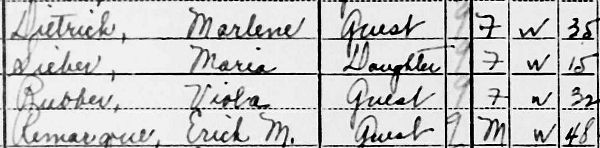
 After a simple search of the indexed 1940 United States census at FamilySearch.org, I finally discovered Marlene Dietrich's name on page 81 of the 84-page census schedule for California Enumeration District (ED) 19-43! Scouring through so many scanned sheets back in April must have made my eyes bleary because I know I viewed this very list. Indeed, Dietrich lived at the Beverly Hills Hotel (which then had the address 1201 Sunset Boulevard). Listed below Marlene is her retinue: daughter Maria Sieber, "secretary" Viola Rubber (a.k.a. "The Rhino"), and Erich Maria Remarque. See the full page for more details. You'll notice that Marlene is only 35, in keeping with her preferred birth year of 1904. You'll also observe that she worked only 8 weeks in 1939--on Destry Rides Again, of course--earning "over $5,000."