Pages

Showing posts with label concerts. Show all posts

10 February 2015

Interview: Marlene Dietrich – bourgeois, geranium-lover

Betty Best interviewed Marlene Dietrich, backstage at London's Golder's Green Hippodrome, in 1965. Special thanks to the Crees Collection for sharing this material.

Marlene Dietrich in her dressing room.
It had been a month since I'd seen her. A month since she'd held out a delicate, tiny hand and agreed to the idea of a private interview with a brief, "Yes, yes, call me at Claridges" –  and sounded as if she meant it. 

But I'd made at least ten telephone calls every day since then, from Brighton to Birmingham and back to London, without ever once getting through to that inimitable, halting voice. A month of pleading with agents and publicity officers, all of whom sounded terrified at the very thought that I should claim a whole hour of Miss Dietrich's time to myself. 

By then my mental picture of her was becoming a little unsure. Perhaps that brief meeting among a horde of people in the excitement of a first arrival had been misleading. Perhaps the apparent ease and friendliness of the magic Marlene was just an effect, switched on like her magnificent stage personality, for an audience which expected it. 

Police cordons 

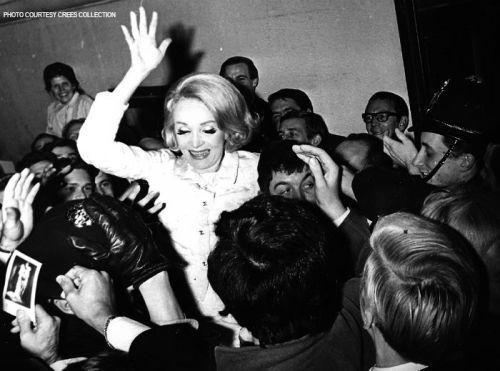
In between times I'd heard of the packed schedule of a tour which stopped in each city for only a week, which included intense rehearsals with each orchestra, with her arranger Burt Bacharach (who flew from the U.S.A. especially), an entire one-woman radio play for the BBC somehow jammed into the London week; of fantastic hold-ups every night after each show while fans besieged the stage doors so that Dietrich could not emerge without special police cordons.

Perhaps I was hoping for too much. Then I got word that she was fed up with English reporters asking about nothing but her age, her looks, her clothes, and that most forbidden of all subjects, her family – about whom she will never speak.

All the signs were against my ever getting to see her at all. Yet, throughout I had a curious belief that it would come off – because of the geranium.

Miss Dietrich had, that first night, told an endearing story: ''I've just made a new LP. The songs of old Berlin as I remember them as a child. They are beautiful songs, real songs of the people. And because they always meant so much to me, I wanted to do everything about this record myself. Even to designing the cover. Me, I'm not an artist. But I had my ideas. I always see Berlin as a grey city – grey walls, streets, everything.

"So I got paints and made a beautiful grey pattern. Then, because I'm not an artist, I went to a stationer's and bought those letters children use to scratch with a pencil and that come out on paper.

"Then on the bar of the 'H' at the end of my name I put a lovely little pot of bright red geraniums. When I took it proudly to the publisher, he said, 'Why the geraniums there?' I tried to explain that it is the flag of the little people in grey cities everywhere. The big gesture of the bourgeois toward beauty. And I am a bourgeois and I love geraniums.

"But, of course, he couldn't understand. Never mind, I kept my geranium on the cover – just as I always keep one in my dressing-room wherever I go."

And sure enough, when finally, after many cancellations, I got to her dressing room at Golder's Green Hippodrome on the outskirts of London, there it was. Not a grand florist's specimen,but a simple little scarlet single in a common terracotta pot sitting on the wash basin in the corner. 

Beside it on the wall was a symbol of that very private side of Dietrich's life she seldom mentions, a
large framed and inscribed portrait of Ernest Hemingway, wearing a polo-necked sweater and looking young and adventurous.

On a previous occasion I had once managed to get her to touch on her great friend ship with this man who wrote of her: "I think she knows more about love than anyone. I know that every time I have seen Marlene Dietrich she has done some thing to my heart and made me happy.''

It was when she was railing against the agonies of work on tour: "It is not the performances I mind. They are fine. Once I am in front of people I can recharge my batteries from them.

''It is the terrible chore of packing and unpacking. Of never having a minute to myself or a second for reading."

Then someone asked who was her favourite author and, suddenly, the whole face softened and glowed. She replied with the single word, "Hemingway."

She began to speak of the great respect and love she felt for him; her voice broke, she turned away with a final, "Life is not the same now he has gone."

18 November 2014

Dietrich in London: 50th Anniversary

Half a century ago, this week, Marlene Dietrich arrived in London to prepare for a concert season in that city. She had previously performed there, at the Café de Paris in the fifties, but that was in cabaret. This would be London's first opportunity to experience her expanded repertoire, in a theatrical event finessed by musical director, Burt Bacharach, and herself.

Dietrich at Heathrow airport, November 1964.

01 November 2014

Dietrich Interviewed: Advice from "An Old German Shoe"

Marlene had recently completed her annual Las Vegas stint and was in the midst of her South American concert tour when this interview, by Lloyd Shearer, was published in an August 1959 edition of Parade:


BOOKERS WHO SCHEDULE the stage appearances of famous show business personalities loosely classify these celebrities in two groups  — talent and freak attractions. 

Marlene Dietrich, who each year is booked into the Sahara Hotel in Las Vegas, the Copacabana in Rio and several other night spots throughout the world at $25,000 a week, is classified as a freak attraction. 

The reason? People will pay to see her regardless of her act — an act in which she sings badly because her tremulous voice lacks timbre and range, and in which she dances inadequately because her dancing is limited to a series of offbeat kicks and cakewalks. And yet Marlene is always a sellout.  Wherever she plays she draws enthusiastic crowds. She stimulates tumultuous ovations. She arouses such awe and envy-inspired audience comment as, “How does she do it at her age?” or “Doesn't she ever grow old?” or “Look at the figure on that woman.” 

At 55, onstage, sheathed in a shimmering side-slit creation designed by Jean Louis, languorously slinking up to a microphone, incredibly immune to the ravages of age, Grandma Dietrich generates more glamor and sex appeal than any other actress you can think of, even those half her age. 

How does she do it? The honest answer is money, technique and style. 

“Let's not fool anyone,” Dietrich candidly declares. “It takes money to be glamorous nowadays. Glamor is what I sell in my act, and it costs plenty. 

Feathers from Argentina

20 May 2014

Дитрих '64

This month marks the fiftieth anniversary of Marlene's 1964 tour of the USSR, where she performed in Moscow and Leningrad.

Marlene was welcomed to Moscow by a group that included actress Tamara Makarova.


On her opening night in Moscow, after 15 minutes of curtain calls, she addressed the audience:

"I have loved you for a long time. I love your music, your poetry, your writers and your artists, but most of all I love your soul. You have no lukewarm feeling. You are either sad or happy. I think I have a Russian soul myself."


05 April 2014

Doctor Dietrich's Best Production? Her Daughter.

[In 1971, Jeffrey Archer organised a charity midnight matinee (to benefit MIND) at Theatre Royal, Drury Lane. It was Marlene Dietrich's first  concert appearance in London for several years. This backstage interview  with both Marlene and Maria Riva, preparing for the show   comes courtesy of the wonderful Crees Collection.]


FRIEND, 
LIVING LEGEND 
AND LIGHTNING TYPIST

by James Green

September 1971: Marlene at Heathrow.
There are many ways of saying Darling. But Marlene Dietrich's way is unique. A mixture of warning, invitation, seduction, plus a mocking suggestion that the men are about to be separated from the boys. But “Dar-ling” she says silkily by way of greeting. And crosses to plant a kiss on my five o'clock shadow. Not at all a bad start backstage at the Drury Lane theatre where tonight at midnight she will hold the football pitch size stage alone for one hour, 45 minutes. It is a charity concert and the audience will be paying up to £50-a-seat to hear her sing 25 songs and turn on the living legend magic.


At the moment she is wearing a navy blue coat with matching trousers, and a floppy-brimmed hat in the same colour pulled down over one eye.

As she checks on songs, running order, lighting, I have a word with her daughter, Maria.

28 November 2013

Dietrich in Vegas: She Glittered And Gleamed So!

Nescafé society” – as Noel Coward dubbed those who frequented Las Vegas – was introduced to “the most glamorous star in the world – the woman and the legend”, Marlene, when Dietrich made her cabaret début at the Sahara Hotel's Congo Room in December 1953.


They worked on me for two years and kept upping the salary until I could no longer refuse,” she explained to the press about her record $ 30 000 per week fee (for a three week season: three shows a night).

I had to come out here to Las Vegas and see the place first. I came here twice before I really decided.

I was really convinced when I came to see Tallulah Bankhead. She did a serious dramatic bit – a Dorothy Parker piece – and you could hear a pin drop. You could never do a thing like that in a New York night club, or in a night club anywhere else.”


On her opening night, Marlene appeared in a flash of sequins and a waft of fur, purred “hello” to an appreciative audience (including Billy Wilder, Van Heflin, Mercedes McCambridge, Louella Parsons, and Jimmy McHugh) and appropriately crooned “Baubles Bangles and Beads” to Buddy Cole's accompaniment.

The “glitter and gleam” promised in the lyric was supplied by designer Jean Louis, who had gathered some sparkle clusters onto a barely-there foundation – a so-called “nude dress”. Marlene insisted that it lived up to its name: “The only thing underneath” the $ 8 000 “revue costume”, she said, was “a gaiter belt to hold the stockings, period.

The Dress caused a press sensation when the opening night's photos made it into newspapers. “It's the most daring gown I've ever seen on a stage,” gushed one longtime newspaper man.

That the photos revealed more than even Dietrich professed to have intended, only added additional sizzle.

These photographs were shot from a low angle, and these rhinestones didn't even register,” Marlene half-heartedly protested, pointing to strategically placed beads at the costume's bust-line. It “wasn't designed to be photographed up close, or to be looked at up close,” she explained. Besides – “this is Las Vegas. If you can't wear it here, you can't wear it anywhere. I have several costumes like this. I will alternate them. I would not want to disappoint any individual audience.”

The show was brief. She sang “The Boys in the Back Room”, “La Vie en Rose”, “You've Got That Look”, “The Laziest Gal in Town”, “Lili Marlene”, “Jonny”, “Lola” and the “inevitable” “Falling in Love Again”.

For the finalé, Marlene changed into her circus ringmaster costume. Max Colpet had written a special lyric for her, “The Beast in Me” (set to “The Entrance of the Gladiators”). With whip in hand, and while show girls in animal costume moved around in and about cages, she sang:

“Lions, tigers, small cats, tall cats
You just name them  – I will tame them …

“There is one beast that was never tamed
And that beast ... that beast is me!

Many men have tried their chance in vain,
One went nuts – two died in France and Spain ...

Do or die, I must discover
My superman, my only lover.
Then I skip my boots and whip
And flip ... and flip ... and flip

Where is that man?”
During the run, Marlene celebrated her (officially, 48th) birthday with a six-tiered, four-hundred pound birthday cake. There were no candles on the cake, jested the staff of the Sahara Hotel, because they “couldn't afford it after paying her that money”. (Not that they had reason to complain – 1,937 people had seen Dietrich perform the previous evening, which had set a Vegas attendance record.)

Working in Las Vegas was “fun” – “and much easier than making films,” but “different than when I sang for the troops during the war. If there'd been servicemen out there when I sang 'Lili Marlene' they would have brought the house down."

I'd like to come back to Las Vegas,” she said near the end of her season. “I don't think any other place can pay the money.

The town was “a funny place”, though: “I always thought that when you're a success, you're held over. Here, the next act is already here, waiting for me to get out. Donald O'Connor has been hanging around for days. I came in here yesterday, and the girls in the line were rehearsing – not for me, but for Donald O'Connor's show.

It gave me a strange feeling.”


13 July 2013

Shine On! Marlene Dietrich, Interviewed at Grosvenor House. London, 1974.

(Thank you to the Crees Collection for sharing yet another gem: this interview with Marlene, preparing for her performances at London's Grosvenor House in 1974.)

by Roger Falk

The omens were not promising. At midnight she had railed at photographers who ambushed her at London Airport. “Why aren’t you all home in your beds?” she snapped, and then, rather than be photographed in a wheelchair, had endured the painful long walk to the terminal building from the aircraft. The next day a surprised radio reporter was bundled away from her suite at the Grosvenor House Hotel in Park Lane. His crime: asking silly questions. A national newspaper writer, awaiting audience, was being softened up by her publicity man. “Now you won’t ask her about her age, her family or her leg ?” he implored. “Don’t be so bloody wet,” came the robust retort. “‘If I don’t ask her about her leg, it’ll be like interviewing Nelson and not  mentioning the eye and the arm.”

17 June 2013

Charles Marawood: Marlene Dietrich's "Boomerang" Baby

Charles Marawood wrote the two songs from “the room of the boomerang” in Marlene’s concert repertoire: her pseudo-rock foray, “Boomerang Baby” and  the haunting anti-war ballad (one of several in Dietrich’s arsenal), “White Grass”.

Born in Sydney in the 1920s, Marawood spent World War II as a member of the AIF; after the war he enrolled at the Sydney Conservatorium to study composition and harmony. He wrote a musical play in the early 1950s but was unable to secure a London production of it. Back in Australia, he continued to write and perform his own songs, also writing for other singers.

He briefly gained recognition in 1965 – around the time of Marlene’s first Australian concert tour – when he supplied all the music for an Aussie music TV series, Boomeride  (which featured both “Boomerang Baby” and White Grass”; a young Olivia Newton-John was one of the performers on the show).


["Boomeride" soundtrack performances of "White Grass" (vocals by Doug Kennedy, above) and "Boomerang Baby" (vocals by Tony Cole, below)]


While Marlene was performing  in Melbourne that year, Marawood auditioned her some of his songs.

Among them was “White Grass” which she thought a “very, very tragic song against war”, finding its theme of a returning soldier “quite a new angle”:   “I was fascinated with the song when he brought it to me because I’m always trying to look for songs that have a meaning, and since “Where Have All the Flowers Gone?” I have never found anything quite like it.”


[Marlene sings "White Grass" ...]

Its antithesis was “Boomerang Baby” -- “a very gay song”.


[... and "Boomerang Baby"]

She decided to include both in her programme. Marawood accompanied Marlene to Sydney, her next stop on the tour, to polish the lyrics. She planned to record both songs in London; this seems not to have happened, although her interpretations are preserved on both her 1968 and 1972 TV specials.

According to Dietrich, they kept in touch. Other Marawood  songs popped up in some  Australian movies and TV series during the 1970s. One producer who worked with him during this time called him “a real eccentric ... he wore way-out clothes, capes and things like that, and his house was crammed full of amazing stuff” and found his music “great. He was very talented, but I don’t think he ever got the recognition he deserved.”


[Composer Charles Marawood sings his own song, "Aussie" (1965)]

When New Zealand singer Jennifer Ward-Lealand included “White Grass” in a 2007 tribute to Dietrich, she had to track down Marawood’s widow to obtain the necessary permissions to record the song.


[More information about Charles Marrawood and the "Boomeride" TV show is available here and here; a needledrop of its  LP soundtrack has been posted here; the photo of Charles Marawood is from this 1965 article in "The Age".]

14 May 2013

Marlene Dietrich Interview: It's the Money I Work For! (1965)


(Thanks to the Crees Collection for sharing this interview with Marlene! The article likely dates from August 1965, when Marlene was doing a British concert tour.)

By Clive Hirschhorn

THE atmosphere round the theatre was thick with reverence. Though there were still two hours to go before Marlene Dietrich would emerge from the stage door after her performance that night, already a crowd of admirers had gathered. The doorman remarked to me that he couldn't remember when business had been so good — and his sentiments and awe were echoed by a young girl, who, with a rubber stamp bearing a facsimile of Miss Dietrich’s autograph, banged out the star’s name on dozens of photographs which would later be distributed to the audience. I was duly beckoned and, to the envy of her adoring fans, was escorted to the Number One dressing room where Marlene was waiting for me. She had just finished a matinee and was clad in a dressing-gown. She was tired — and not even the heavy make-up she was wearing could. disguise this fact; or hide the lines on her face or the fatigue in her eyes. La Dietrich, I discovered, was human after all.

GLAMOUR?

Why, at 61, I asked her, did she continue to work so hard? (Her engagement book is full for the next two years.)

“For  the money.” she said flatly.

I looked at her somewhat surprised. “Yes. For the money.” She repeated. “What else for ? ”

She leaned forward and picked up a publicity hand-out which advertised the dates of her future concerts — in Golders Green,  Edinburgh,  Manchester, Liverpool and Bristol.  She had just finished engagements in Brighton and Birmingham.

“Do you think this is glamorous? That this is a great life,  and that I do it for my health?  Well, it isn’t. It's hard work. And who would work if they didn't have to? 

25 April 2013

Marlene Dietrich Live In Amsterdam: Wenn ich mir was wünschen dürfte

Previously unissued live recording of Marlene singing Friedrich Hollaender's great song, "Wenn ich mir was wünschen dürfte" live at the Tuschinsky Theatre in Amsterdam, as broadcast on Dutch radio in 1960:

12 April 2013

Dietrich at the Café de Paris: Perfume from Spain

Marlene's 1954 debut at London's Café de Paris  has become as legendary, and was  judging by the recording made of the evening  as lovely as the star herself, who was  introduced to the nightclub's chic clientèle by Noël Coward. 

Less remembered are her return visits to the club, in 1955 and 1958  making the article republished below (shared thanks to the generosity of the Crees Collection!) a delightful read. The clippping, while not dated and sourced, is likely a later recounting by journalist and wit Nancy Spain of her introduction to, and for, Dietrich in 1955.


MY evening out with Marlene Dietrich began when the Café de Paris — London's glittery night-spot — came on the telephone and said, ‘We’d like you to introduce Miss Dietrich on Wednesday. Douglas Fairbanks does it on Monday . . . Helen Hayes, the first lady of the American theatre, on the Tuesday . . .' And I began to babble incoherently.

How would you feel if you were suddenly to come face to face with The Legend, the Top Girl of the movies for the last twenty years, the woman to whom author Ernest Hemingway always takes his manuscripts for literary approval, the most glamorous woman in the world? And now, let alone coming face to face with her, I was to introduce her to a crowd of the celebrated and near celebrated, the distinguished and near distinguished who go to make up the clientele at the Café de Paris. ‘You may bring two friends,’ they told me.

04 October 2012

Thom Nickels' "Daddy, Buy Me That" (Pt. 2)

Many moons ago, I shared the first part of an interview that Thom Nickels conducted with Marlene Dietrich pal John Banks, called "Daddy, Buy Me That!" Well, if you weren't sold on Banks' story, maybe this second part will sway you. Banks discusses Dietrich's envy and jealousy toward Angie Dickinson, his thoughts about Maria Riva's depiction of her mother, the time he gave Marlene a Twiggy make-over, and much more.  I'll add my two-cents in brackets. Oh, and in case anyone was wondering, I never got around to contributing to the Paramount centennial blogathon, but I will post what I had intended someday--hopefully before the studio celebrates its bicentennial. Now, please enjoy . . .

Daddy, Buy Me That!

part two

by Thom Nickels


  Turbulent Sixties


Banks says that the '60s were a hard time for Marlene because she didn't like the fact that age was waning her power.

"In her book, Maria talks about Marlene arriving home from Washington, D.C. and walking in her apartment waving her panties in the air and saying that she'd just had it off with John Kennedy, and that you could still smell him on them, or whatever." Banks thinks this is a crock and maintains that, because Marlene was 60, he doesn't think that John Kennedy would have been interested. "Especially since they'd known each other since they were [e.g., he was?] small. She and Joe Kennedy spent the summer of 1938 or 1939 on the Riviera together when Kennedy was a child. But would a child of his age have kept that image of that super woman until 1960?" Banks says he doubts it.

"When she finally faced age, she realized that things finally had to stop. She could have gone on having affairs right up until her death, but she didn't because she wasn't offering what she had before. She also began to drink in the '60s. She drank as much tea and honey as she drank scotch when I met her," Banks remembers. "She also drank beer. We went to restaurants, and I would always order a Pilsner, and she would always order a half a bottle of champagne. She'd get the champagne, and I'd get the beer, but we'd switch . . . I thought drinking champagne was still very exciting. She was very European. She drank beer at noon. She drank beer with meals. She was German, darling. She was a wonderful German broad."

Thalidomide Babies


"What she'd been all her life, even in those pictures that we see of her in the 1920s when she's kind of hefty, was a gorgeous woman. People wrote about her then as being absolutely fabulous looking. She had reddish blond hair. She had this white-white complexion, a great bone structure. I have very few photos of me with Marlene. I would have felt as if I was insulting her if I'd asked to do photographs. I couldn't say to her, 'Can I have my photograph taken with you, please?' I didn't think she would have liked that. I think she rather liked the fact that I didn't.

"She was a funny broad. She had a good sense of humor. The only thing we did not joke about was 'the image.' That was work, and you did not fuck around with work. But, otherwise, she was pretty funny, and she could laugh at herself. She liked practical jokes like tripping people. She had great gallows humor. For instance, she'd make terrible jokes about thalidomide babies and then say, 'Oh, that's terrible!'"

07 September 2012

Earl Wilson's Vintage Gossip Bites: The Broadway Edition

At The Last Goddess, we devour good gossip; below are some tasty morsels from New York-based Earl Wilson's syndicated  column, written at the time of Marlene's two Broadway triumphs in 1967 and 1968:


  • MONTREAL -- Maurice Chevalier, "a very happy old man" in his own words, delivered himself of the provocative opinion here the other day that "Marlene Dietrich had the guts that Greta Garbo never had" in continuing her career and that Garbo "must not be very gay now not working." ... "I don't approve of Garbo not working," Chevalier said. "she got so scared because something she did went wrong, and she didn't dare to come back, and she has refused everything. If she had kept working she would still be the great Garbo, whereas now Dietrich is greater than Garbo. She would have had to take older parts so she would be the great old lady of the screen. It is better to be a great old lady than just a souvenir." Chevalier was sure that Marlene -- "who has a lot of guts and it's surprising to find guts in one so feminine" -- will be a big hit in her one-woman singing, dancing show which, he pointed out, "is not her profession, but a new one for her". (5 August 1967)


    • Marlene Dietrich insists upon a special stage door watchman for her one woman show, to protect a gown allegedly costing $ 50,000. Advance word is that she's so good and lovely, that "she performs for an hour and 20 minutes, then takes bows for 40 minutes". (9 October 1967)


    • Marlene Dietrich was escorted to El Morocco the other morning by Lord Snowdon, Princess Margaret's husband who is here on business, and Alexander Lieberman of Vogue, and Mrs Lieberman. For supper (or breakfast) they had scrambled eggs with red wine. Several beautiful woman such as Mrs Pat Uchitel were there, and I asked what they noticed. They replied, "Marlene's figure." ... "Isn't she TOO thin?" asked somebody near me ... "A woman," they shrieked, is NEVER too thin!" (Is that right?) (24 October 1967)

    • Marlene Dietrich rejected a 50Gs-a-week offer from Miami Beach Deauville, "but I'd like to vacation there". (18 November 1967)

    • Marlene Dietrich told the Billy Reeds she'll go into white tie and tails again when she does Die Fledermaus in Vienna next summer. (19 November 1967)


    • Marlene Dietrich shelved a return to NY -- but may play Osaka, Japan, Fair in the mid-1970s. (25 January 1968)


    •  The Marlene Dietrich triumphal return had some light moments. The "white mink" floor-length coat -- or was it ermine? -- turned out to be swans' down (from the belly of a swan), and it was gorgeous, and I may start breeding swans ... Producer Alexander H. Cohen was funny when I mentioned to him that one bouquet-thrower, who also threw love beads, which Marlene promptly put on, was working both aisles, flinging flowers from one side to the other, and was later seen backstage. "Those flowers cost me a lot of money," joked Producer Cohen, "and Marlene won't let me use them twice." Marlene wore a Jean Louis silk net gown with bugle beads and crystals -- and now jewelry -- and as she took her short little hobble-skirted steps across the stage, bowed the deepest, prettiest bow in history, and waived from the parted red curtains, we thought she is the greatest showman of our time. (10 October 1968)