Pages

Showing posts with label concert. Show all posts

10 February 2015

Interview: Marlene Dietrich – bourgeois, geranium-lover

Betty Best interviewed Marlene Dietrich, backstage at London's Golder's Green Hippodrome, in 1965. Special thanks to the Crees Collection for sharing this material.

Marlene Dietrich in her dressing room.
It had been a month since I'd seen her. A month since she'd held out a delicate, tiny hand and agreed to the idea of a private interview with a brief, "Yes, yes, call me at Claridges" –  and sounded as if she meant it. 

But I'd made at least ten telephone calls every day since then, from Brighton to Birmingham and back to London, without ever once getting through to that inimitable, halting voice. A month of pleading with agents and publicity officers, all of whom sounded terrified at the very thought that I should claim a whole hour of Miss Dietrich's time to myself. 

By then my mental picture of her was becoming a little unsure. Perhaps that brief meeting among a horde of people in the excitement of a first arrival had been misleading. Perhaps the apparent ease and friendliness of the magic Marlene was just an effect, switched on like her magnificent stage personality, for an audience which expected it. 

Police cordons 

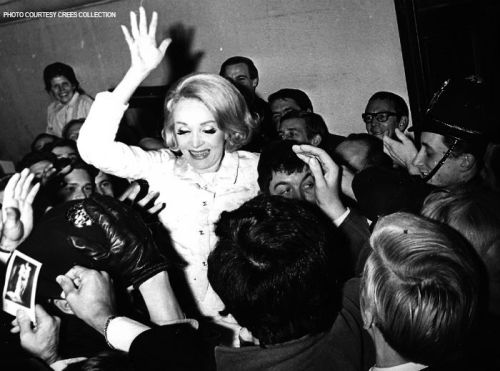
In between times I'd heard of the packed schedule of a tour which stopped in each city for only a week, which included intense rehearsals with each orchestra, with her arranger Burt Bacharach (who flew from the U.S.A. especially), an entire one-woman radio play for the BBC somehow jammed into the London week; of fantastic hold-ups every night after each show while fans besieged the stage doors so that Dietrich could not emerge without special police cordons.

Perhaps I was hoping for too much. Then I got word that she was fed up with English reporters asking about nothing but her age, her looks, her clothes, and that most forbidden of all subjects, her family – about whom she will never speak.

All the signs were against my ever getting to see her at all. Yet, throughout I had a curious belief that it would come off – because of the geranium.

Miss Dietrich had, that first night, told an endearing story: ''I've just made a new LP. The songs of old Berlin as I remember them as a child. They are beautiful songs, real songs of the people. And because they always meant so much to me, I wanted to do everything about this record myself. Even to designing the cover. Me, I'm not an artist. But I had my ideas. I always see Berlin as a grey city – grey walls, streets, everything.

"So I got paints and made a beautiful grey pattern. Then, because I'm not an artist, I went to a stationer's and bought those letters children use to scratch with a pencil and that come out on paper.

"Then on the bar of the 'H' at the end of my name I put a lovely little pot of bright red geraniums. When I took it proudly to the publisher, he said, 'Why the geraniums there?' I tried to explain that it is the flag of the little people in grey cities everywhere. The big gesture of the bourgeois toward beauty. And I am a bourgeois and I love geraniums.

"But, of course, he couldn't understand. Never mind, I kept my geranium on the cover – just as I always keep one in my dressing-room wherever I go."

And sure enough, when finally, after many cancellations, I got to her dressing room at Golder's Green Hippodrome on the outskirts of London, there it was. Not a grand florist's specimen,but a simple little scarlet single in a common terracotta pot sitting on the wash basin in the corner. 

Beside it on the wall was a symbol of that very private side of Dietrich's life she seldom mentions, a
large framed and inscribed portrait of Ernest Hemingway, wearing a polo-necked sweater and looking young and adventurous.

On a previous occasion I had once managed to get her to touch on her great friend ship with this man who wrote of her: "I think she knows more about love than anyone. I know that every time I have seen Marlene Dietrich she has done some thing to my heart and made me happy.''

It was when she was railing against the agonies of work on tour: "It is not the performances I mind. They are fine. Once I am in front of people I can recharge my batteries from them.

''It is the terrible chore of packing and unpacking. Of never having a minute to myself or a second for reading."

Then someone asked who was her favourite author and, suddenly, the whole face softened and glowed. She replied with the single word, "Hemingway."

She began to speak of the great respect and love she felt for him; her voice broke, she turned away with a final, "Life is not the same now he has gone."

05 April 2014

Doctor Dietrich's Best Production? Her Daughter.

[In 1971, Jeffrey Archer organised a charity midnight matinee (to benefit MIND) at Theatre Royal, Drury Lane. It was Marlene Dietrich's first  concert appearance in London for several years. This backstage interview – with both Marlene and Maria Riva, preparing for the show –  comes courtesy of the wonderful Crees Collection.]


FRIEND, 
LIVING LEGEND 
AND LIGHTNING TYPIST

by James Green

September 1971: Marlene at Heathrow.
There are many ways of saying Darling. But Marlene Dietrich's way is unique. A mixture of warning, invitation, seduction, plus a mocking suggestion that the men are about to be separated from the boys. But “Dar-ling” she says silkily by way of greeting. And crosses to plant a kiss on my five o'clock shadow. Not at all a bad start backstage at the Drury Lane theatre where tonight at midnight she will hold the football pitch size stage alone for one hour, 45 minutes. It is a charity concert and the audience will be paying up to £50-a-seat to hear her sing 25 songs and turn on the living legend magic.


At the moment she is wearing a navy blue coat with matching trousers, and a floppy-brimmed hat in the same colour pulled down over one eye.

As she checks on songs, running order, lighting, I have a word with her daughter, Maria.

28 November 2013

Dietrich in Vegas: She Glittered And Gleamed So!

“Nescafé society” – as Noel Coward dubbed those who frequented Las Vegas – was introduced to “the most glamorous star in the world – the woman and the legend”, Marlene, when Dietrich made her cabaret début at the Sahara Hotel's Congo Room in December 1953.


“They worked on me for two years and kept upping the salary until I could no longer refuse,” she explained to the press about her record $ 30 000 per week fee (for a three week season: three shows a night).

“I had to come out here to Las Vegas and see the place first. I came here twice before I really decided.

“I was really convinced when I came to see Tallulah Bankhead. She did a serious dramatic bit – a Dorothy Parker piece – and you could hear a pin drop. You could never do a thing like that in a New York night club, or in a night club anywhere else.”


On her opening night, Marlene appeared in a flash of sequins and a waft of fur, purred “hello” to an appreciative audience (including Billy Wilder, Van Heflin, Mercedes McCambridge, Louella Parsons, and Jimmy McHugh) and appropriately crooned “Baubles Bangles and Beads” to Buddy Cole's accompaniment.

The “glitter and gleam” promised in the lyric was supplied by designer Jean Louis, who had gathered some sparkle clusters onto a barely-there foundation – a so-called “nude dress”. Marlene insisted that it lived up to its name: “The only thing underneath” the $ 8 000 “revue costume”, she said, was “a gaiter belt to hold the stockings, period.”

The Dress caused a press sensation when the opening night's photos made it into newspapers. “It's the most daring gown I've ever seen on a stage,” gushed one longtime newspaper man.

That the photos revealed more than even Dietrich professed to have intended, only added additional sizzle.

“These photographs were shot from a low angle, and these rhinestones didn't even register,” Marlene half-heartedly protested, pointing to strategically placed beads at the costume's bust-line. It “wasn't designed to be photographed up close, or to be looked at up close,” she explained. Besides – “this is Las Vegas. If you can't wear it here, you can't wear it anywhere. I have several costumes like this. I will alternate them. I would not want to disappoint any individual audience.”

The show was brief. She sang “The Boys in the Back Room”, “La Vie en Rose”, “You've Got That Look”, “The Laziest Gal in Town”, “Lili Marlene”, “Jonny”, “Lola” and the “inevitable” “Falling in Love Again”.

For the finalé, Marlene changed into her circus ringmaster costume. Max Colpet had written a special lyric for her, “The Beast in Me” (set to “The Entrance of the Gladiators”). With whip in hand, and while show girls in animal costume moved around in and about cages, she sang:

“Lions, tigers, small cats, tall cats
You just name them  – I will tame them …

“There is one beast that was never tamed
And that beast ... that beast is me!

Many men have tried their chance in vain,
One went nuts – two died in France and Spain ...

Do or die, I must discover
My superman, my only lover.
Then I skip my boots and whip
And flip ... and flip ... and flip

Where is that man?”
During the run, Marlene celebrated her (officially, 48th) birthday with a six-tiered, four-hundred pound birthday cake. There were no candles on the cake, jested the staff of the Sahara Hotel, because they “couldn't afford it after paying her that money”. (Not that they had reason to complain – 1,937 people had seen Dietrich perform the previous evening, which had set a Vegas attendance record.)

Working in Las Vegas was “fun” – “and much easier than making films,” but “different than when I sang for the troops during the war. If there'd been servicemen out there when I sang 'Lili Marlene' they would have brought the house down."

“I'd like to come back to Las Vegas,” she said near the end of her season. “I don't think any other place can pay the money.”

The town was “a funny place”, though: “I always thought that when you're a success, you're held over. Here, the next act is already here, waiting for me to get out. Donald O'Connor has been hanging around for days. I came in here yesterday, and the girls in the line were rehearsing – not for me, but for Donald O'Connor's show.

“It gave me a strange feeling.”


13 July 2013

Shine On! Marlene Dietrich, Interviewed at Grosvenor House. London, 1974.

(Thank you to the Crees Collection for sharing yet another gem: this interview with Marlene, preparing for her performances at London's Grosvenor House in 1974.)

by Roger Falk

The omens were not promising. At midnight she had railed at photographers who ambushed her at London Airport. “Why aren’t you all home in your beds?” she snapped, and then, rather than be photographed in a wheelchair, had endured the painful long walk to the terminal building from the aircraft. The next day a surprised radio reporter was bundled away from her suite at the Grosvenor House Hotel in Park Lane. His crime: asking silly questions. A national newspaper writer, awaiting audience, was being softened up by her publicity man. “Now you won’t ask her about her age, her family or her leg ?” he implored. “Don’t be so bloody wet,” came the robust retort. “‘If I don’t ask her about her leg, it’ll be like interviewing Nelson and not  mentioning the eye and the arm.”

17 June 2013

Charles Marawood: Marlene Dietrich's "Boomerang" Baby

Charles Marawood wrote the two songs from “the room of the boomerang” in Marlene’s concert repertoire: her pseudo-rock foray, “Boomerang Baby” and  the haunting anti-war ballad (one of several in Dietrich’s arsenal), “White Grass”.

Born in Sydney in the 1920s, Marawood spent World War II as a member of the AIF; after the war he enrolled at the Sydney Conservatorium to study composition and harmony. He wrote a musical play in the early 1950s but was unable to secure a London production of it. Back in Australia, he continued to write and perform his own songs, also writing for other singers.

He briefly gained recognition in 1965 – around the time of Marlene’s first Australian concert tour – when he supplied all the music for an Aussie music TV series, Boomeride  (which featured both “Boomerang Baby” and White Grass”; a young Olivia Newton-John was one of the performers on the show).


["Boomeride" soundtrack performances of "White Grass" (vocals by Doug Kennedy, above) and "Boomerang Baby" (vocals by Tony Cole, below)]


While Marlene was performing  in Melbourne that year, Marawood auditioned her some of his songs.

Among them was “White Grass” which she thought a “very, very tragic song against war”, finding its theme of a returning soldier “quite a new angle”:   “I was fascinated with the song when he brought it to me because I’m always trying to look for songs that have a meaning, and since “Where Have All the Flowers Gone?” I have never found anything quite like it.”


[Marlene sings "White Grass" ...]

Its antithesis was “Boomerang Baby” -- “a very gay song”.


[... and "Boomerang Baby"]

She decided to include both in her programme. Marawood accompanied Marlene to Sydney, her next stop on the tour, to polish the lyrics. She planned to record both songs in London; this seems not to have happened, although her interpretations are preserved on both her 1968 and 1972 TV specials.

According to Dietrich, they kept in touch. Other Marawood  songs popped up in some  Australian movies and TV series during the 1970s. One producer who worked with him during this time called him “a real eccentric ... he wore way-out clothes, capes and things like that, and his house was crammed full of amazing stuff” and found his music “great. He was very talented, but I don’t think he ever got the recognition he deserved.”


[Composer Charles Marawood sings his own song, "Aussie" (1965)]

When New Zealand singer Jennifer Ward-Lealand included “White Grass” in a 2007 tribute to Dietrich, she had to track down Marawood’s widow to obtain the necessary permissions to record the song.


[More information about Charles Marrawood and the "Boomeride" TV show is available here and here; a needledrop of its  LP soundtrack has been posted here; the photo of Charles Marawood is from this 1965 article in "The Age".]

14 May 2013

Marlene Dietrich Interview: It's the Money I Work For! (1965)


(Thanks to the Crees Collection for sharing this interview with Marlene! The article likely dates from August 1965, when Marlene was doing a British concert tour.)

By Clive Hirschhorn

THE atmosphere round the theatre was thick with reverence. Though there were still two hours to go before Marlene Dietrich would emerge from the stage door after her performance that night, already a crowd of admirers had gathered. The doorman remarked to me that he couldn't remember when business had been so good — and his sentiments and awe were echoed by a young girl, who, with a rubber stamp bearing a facsimile of Miss Dietrich’s autograph, banged out the star’s name on dozens of photographs which would later be distributed to the audience. I was duly beckoned and, to the envy of her adoring fans, was escorted to the Number One dressing room where Marlene was waiting for me. She had just finished a matinee and was clad in a dressing-gown. She was tired — and not even the heavy make-up she was wearing could. disguise this fact; or hide the lines on her face or the fatigue in her eyes. La Dietrich, I discovered, was human after all.

GLAMOUR?

Why, at 61, I asked her, did she continue to work so hard? (Her engagement book is full for the next two years.)

“For  the money.” she said flatly.

I looked at her somewhat surprised. “Yes. For the money.” She repeated. “What else for ? ”

She leaned forward and picked up a publicity hand-out which advertised the dates of her future concerts — in Golders Green,  Edinburgh,  Manchester, Liverpool and Bristol.  She had just finished engagements in Brighton and Birmingham.

“Do you think this is glamorous? That this is a great life,  and that I do it for my health?  Well, it isn’t. It's hard work. And who would work if they didn't have to? 

16 March 2013

What The Dresser Saw

Marlene Dietrich and Gene Lovelle
Marlene’s dresser, Gene Lovelle (married to the star’s guitarist, Chic Lovelle) first joined the Dietrich troupe  during its 1966 Warsaw season .
“There was no question of payment. Marlene would be paying my fares and hotels, and I would be together with my husband,” Gene later recalled. “With the enthusiasm of ignorance, I convinced myself that after years as a dresser helping little girls in and out of ballet costumes, I could cope with an international star.” Marlene had dismissed the Polish dresser that had been supplied – “I don’t want a strange dresser round me,  they stare so” – and proceeded to show Gene what would be expected of her.
In 1985, she shared memories of life on the road:
·         New York, 1967: ... at rehearsals she was very demanding and kept everyone on their toes. A violinist was ticked off for wearing short socks ... ‘ they come to see my legs, not yours.’

·         San Francisco, 1968: She liked her dressing room to be functional and sparsely furnished, but in San Francisco, it had been furnished and bedecked with beautiful antiques and rich brocades. She took one look and said to me: ‘Let’s move in next door,  honey,  who needs all this!’

·         Paris, 1973: Marlene excelled herself before one of the most exquisitely-dressed and sophisticated audiences we had ever seen. Among the celebrities ... who came backstage after the performance, was a very well-known female singer who, overcome and in tears at Marlene’s performance, embraced her. Marlene seemed equally moved. A moment later she turned to me and whispered,  ‘Who was that,  honey?’

02 September 2012

Marlene '59


Marlene Dietrich at the Sahara Hotel, 1959.
 When Marlene opened at the Sahara Hotel's Conga Room in May 1959, she gave 'em legs -- and feathers. Her dress, a beaded Jean Louis number with a thigh-high slit, was topped with extravagant yellow plumage. (The costume also came in sedate black, but photos of Dietrich wearing it in actual performance are hen's teeth).

She sang her usual suspects but included an odd  repertoire choice: Johnny Cash's "Don't Take Your Gun To Town".

In 1959, Marlene also announced her TV debut. Press were told that her upcoming performances in Paris would be filmed in colour, directed by Orson Welles. In the end, the special -- a French-language performance filmed for an American TV audience -- didn't happen, but Marlene  did  make her TV debut that year, without fuss, while on tour in Brazil.


Marlene makes her TV debut on Brazil's TV Tupi. With host, Jayce Campos (1959).

The show, on the TV-TUPI channel, was presented by Jayce Campos. Dietrich appeared in her top hat and tails to sing "The Boys in the Backroom" and "Falling in Love Again". After some chat, she changed into a dress for a final number.

Although it is a studio recording with overdubbed applause, the LP, Dietrich in Rio gives a good representation of the material Marlene sang on her South American Tour.

South American exuberance gave way to Parisian jubilation when Marlene performed at the Théâtre de l'Étoile in November. Orson Welles came for the opening, as did Jean Cocteau and Noel Coward. Coward thought Marlene too brassy, but liked her rendition of "One For My Baby":


(The entire performance, including Maurice Chevalier's introduction, is available as a digital download on itunes. Although the sound quality is sub-par, it is an interesting historical artifact.)

07 August 2012

25th February 1966, Marlene in Poland for the second time

       On 25th February 1966, Marlene Dietrich was travelling to Poland for the second time.
As 'usual', she was greated by Pagart (Polish Art Agency). She wore beige coat and (it seems) floral print headscarf. Marlene went to the Bristol Hotel (the one in which she stayed back in 1964).

You can watch the airport arrival and Marlene during concert in 1966 in Warsaw here...:

...and something from a fan's private collection, including Polish magazine covers from 60s here(I hope you can watch this one).

 The plan was to give 13 concerts (6 in Warsaw, 5 in Gdańsk and 2 in Wrocław), then get back to Paris to get some rest as her health was really bad those days: in her journal she was writing about insomnia, back pain and frequent bleedings. Despite this, she gave all 13 concerts and didn't stop rehearsing with the orchestra.

She traveled by plane and train from town to town. Even though most of the organisors were able to provide decent conditions, in Gdańsk there were some problems; she didn't quite like the Grand Hotel in nearby Sopot, the stage location wasn't good either: she sang in shipyard which was just next to the railway; trains were so loud they interrupted the songs. You can find photos from Gdańsk airport right here. This Chanel (?) suit suited her so well. :)

Big highlights from Dietrich's second visit to Poland were her meetings with Polish artist: musicians (you can see beautiful Marlene with two well known pianist here), actors, among which the most important person was Cybulski. She met him in Wrocław, when she was staying in Monopol hotel, where eventually Cybulski also decided to spend some time. They got along immediately; she knew his movies; they spend quite a lot time together and when it was high time for her to get back to Warsaw, he escorted her to the railway station. Afterwars, they started to exchange letters.

After concerts in Warsaw and a glass of wine drank with musicians, Marlene headed for airport. She declared she wanted to return to Poland once more...but unfortunatelly, it has never happened.

21 July 2012

Thom Nickels' "Daddy, Buy Me That" (Pt. 1)

For a blog entry, this is a long read, which is why I'm dividing it into 2 parts. When I first read about Marlene Dietrich's friend John Banks and sought information about him, I learned that a writer named Thom Nickels had published his interview with Banks in 2003. Unfortunately, it was no longer available online, which led to me emailing Nickels to obtain the text. Nickels kindly sent me what was far more than a brief interview. In fact, it's quite a substantial piece called "Daddy, Buy Me That," which I hope will be enlighten those of you who are casual Dietrich admirers and corroborate the beliefs of those of you who are hardcore Marlenephiles. I have made some minor edits (e.g., formatting, punctuation, some names, spelling, and occasional bracketed notes) and added photos, but what you'll read below is almost exactly what appears on Nickels' typed manuscript. As for whether Banks makes any inaccurate statements, I will leave that for you to highlight in the comments section because I'm far more impressed by Banks' extensive knowledge of Marlene.

Because I tend to devour as much as I can when I find writers who interest me, I'll add that I've read the Kindle edition of Nickels' Walking on Water & After All This. I suppose that the two novellas fit within the genre term "speculative fiction," but both are also imbued with humor and cultural references, which is why I intend to read more of Nickels' work. Now, for what you're here to read!

Daddy, Buy Me That!

by Thom Nickels

In Montreal's last remaining Anglo gay bar, La Mystique, the bartender, John Banks, talks with the customers.

The talk is rarely about Marlene Dietrich, if only because John says everyone he knows is sick of hearing about her. The fact is, they've heard it all. How she talked. That her favorite food was hamburger. That when she had people over she'd crave odd foods in the middle of drinks and offer to make ice cream sundaes. That she lived to be 91 years old and spent the last 14 years of her life, like Garbo, in solitude.

Banks knows so much about Marlene Dietrich because for 12 years he worked as her personal assistant both in the United States and Europe.

Dietrich, the icon--the gay icon, as Banks insists--has given the world more than 34 films, including The Blue Angel, Morocco, Blonde Venus, Shanghai Express, The Devil Is a Woman, and The Garden of Allah. Discovered by director Josef von Sternberg in 1929, she came to Hollywood in 1930. A well-educated woman who played the violin and piano and spoke several languages, Banks says she was definitely "not the Hollywood movie star but the kind of well-rounded figure we don't see today."

So it's plenty good, yes, to be shaking the hand that once comforted the great legend in various hotel rooms around the world.

In his home, some 15 minutes by cab from La Mystique, the 60-something Banks opens a bottle of wine. By now I'm fully aware that the precise quality of his speaking voice is matched by a manner that is as unambiguous as his opinions. With us is Edward, a little man from Toronto who attached himself to us in a bar the minute he heard us talking about Dietrich. Inviting him to come along, in  Montreal terms, was easy, since strangers easily become friends here.

10 July 2012

Marlene Dietrich's Photographers: The Concert Years

Marlene Dietrich photographed by William Claxton (Sands Hotel, Las Vegas, 1959)
Dietrich photographed by Claxton
(Sands Hotel, Las Vegas, 1959)
[UPDATE: Thanks for your responses, all! I've added more entries on February 16, 2013 and will continue doing so!]

Help! I'm beginning to wrangle disparate online Marlene Dietrich resources into quasi-bibliographies. This is a long-term project, and you can contribute by adding links to content in the comments section.

Because many of you are particularly fond of Dietrich's concert career, I've decided to start with this period. I've also chosen to focus first on the photographers who had the honor of gazing at Marlene through their lenses.

After you share links with me, I'll edit this fledgling bibliography to reflect our collective information, which will hopefully become comprehensive and organized. Specifically, you can direct me to photographers I've failed to mention, links to photos or sites with photos, specific dates, places, events, etc. Also, if any prints are available for purchase, let me know where and for what price.

To show you how much I need your participation, I'll begin this bibliography with an sparse list of Marlene Dietrich photographers. Remember, you need to aid me in making this decent because apathetic consumption makes me weary.

Aarons, Slim

New York City (1959)

April in Paris Ball at the Waldorf-Astoria Hotel

images

Arnold, Eve

Paris (May 1962) 

The Olympia

images

Basch, Peter

Edinburgh (August 23-28?, 1965)

Royal Lyceum Theater?

images

Claxton, William

Las Vegas (Spring 1959)

Sands Hotel

images

text/video
  • one (Digital Journalist) *Claxton recalls his meeting with Dietrich in a video interview; includes transcript

Dauman, Henri

New York City (1959)

[April in Paris Ball at the Waldorf-Astoria Hotel?]

images

Dean, Loomis 

Las Vegas (December? 1953)

The Sahara Hotel and Casino

images

Eijsten, Lili

Netherlands (1963)

images

Erwitt, Elliott

New York City (1959)

April in Paris Ball at the Waldorf-Astoria Hotel

images

Fischer, Walter

Las Vegas (February 19-March 21?, 1962)

Riviera Club

images

Fournier, Pierre

Paris (May 1962) 

The Olympia

images

Freston, George 

London (November 4, 1963)

Prince of Wales Theatre

images

Gragnon, François 

Paris (November 27, 1959)

Theatre de l'Etoile 

images

Hanekroot, Gijsbert

Amsterdam (January 27, 1975)

Theatre Carre

images

List, Herbert

Munich (May 27, 1960)

Deutsches Theater

images

McDowall, Roddy

New York City (October 1967)

Lunt-Fontanne Theatre

images

Meisert, Harald

Bad Kissingen (May 20, 1960)

Kurhaus

images

Morphet, Chris

London (November 1962)

Golders Green Hippodrome

images

Nisberg, Jack

Paris? (1959?)

images

O'Neill, Terry

London (February? 1975)

New Wimbledon Theatre?

images

Parkinson, Norman

London (1955)

Cafe de Paris

images

Redfern, David

London (February 1975)

New Wimbledon Theatre

images

Riva, Peter

London (1972)

Queen's Theatre

images

Whitmore, James

Berlin (May 1960)

images

21 April 2012

Marlene's first visit to Warsaw, 16th January 1964.

Hello! My name is Ewa and I want to bring you to all materials connected to Dietrich which were written in Polish, as few people worldwide know it and therefore it's hard for them to get more information about Marlene.

Lots of facts here are based on wonderful book Marlene by Angelika Kuźniak. If it's ever published in English, you should read it!

She took a trip via plane, arrived with 35 pieces of luggage. Kuźniak has found a list of what one of the suitcases contained: there were furs, night gowns, scarfs, hats, shoes and much more. She had lots of clothes prepared for really low temperatures, which aren't typical for weather in Poland. Later she said that at Dior they had made her buy a fur as they had been so convinced winter in this part of Europe is severe.

She arrived at Warsaw airport just after 6 p.m. After she was transported into "Europejski" Hotel, she was disgusted. Her room was not warm enough and closets not big enough; so Pagart (Polish Art Agency) transferred her to Hotel Bristol. It was very noisy, but overall acceptable--its Art Deco elegance seemed to be a good choice. After she had disinfected the bathrooms, there was the time for press conferences, which she disliked - as she used to put it, "always the same questions" were asked.

People in hotel had observed that Marlene's day-to-day routine in Warsaw always included eating breakfast (with a sip-or more-of champagne,of course), writing letters and rehearsing at the Buffo Theatre. Her stage preparations included putting on make-up, eyelashes from Anker & Lovbo of Copenhagen, placing the sterile needles to lift up her face, putting on a dress and a coat made of swans' down.

Her first concert took place on 18th January in Sala Kongresowa, one of Poland's captial's most sumptous places. Before Dietrich's, there was a performance of Czesław Niemen with his band Niebiesko-Czarni; they were extremely popular at that time. Dietrich was under charm of his song "Czy mnie jeszcze pamiętasz"("Do you still remember me"); later, she used it's melody, wrote the words and performed it many times under the title "Mutter, hast du mir vergeben". I've found nice video about this:


The concerts were a big success. The effect was admired overall by 18 000 people-within few days. (Apart from performances at Kongresowa, she sang few songs in medical students' club-what a shame I didn't live back there, nowadays these clubs are so bad..!).

During her last concerts, she addressed the audience, thanked them and said she was touched and full of awe for polish courage during war. Marlene wrote down in her notebook that she has never experienced such warmth from any audience as from Polish one. She received many letters from fans, lots of them referred to war times, as Marlene anti-Nazi attitude was (and still is) very appreciated in country that had been invaded by Hitler. Dietrich showed some interest in war history, she visited lots of monuments commemorating what had happened between 1939 and 1945. She said she felt guilty for the German nation and glad that Warsaw was still standing, despite the fact that Hitler had wanted its complete destruction.

A total amount of 150 photos were taken during her performances, but no one has ever seen them, 'cause Dietrich hated them and tore them up, refusing to pay the photographer ;) She left Warsaw on the 22nd of January.

28 January 2012

Polskie Radio Gold

Terry Sanderson pointed me to a recently-posted Polskie Radio interview that Marlene Dietrich gave during her first Warsaw concert appearance in 1964, which you can hear here. Typically, introductions and commentary are rife with well-known biographical facts, but hosts Anna Piwowarska and Peter Gentle share Poland-related Dietrichiana that make the entire program--not just the 1964 interview--worth hearing.

With anecdotes from Angelika Kuźniak's Polish-language biography on Dietrich, Marlene, the hosts blend the personal with the professional. Gentle calls Dietrich "eccentric" for bringing 35 suitcases, claiming to have thin eyelids, and cleaning her hotel bathroom with chloroform. Piwowarska speculates that Dietrich banned photography at her concert because the flash cameras would have exposed her mythical foundation. Imagine what Dietrich would do if faced with the TSA's full-body scanners!

Piwowarska and Gentle relate many more stories, but I do want to highlight a professional and Poland-related one: Czesław Niemen led Dietrich's warm-up band and performed "Czy mnie jeszcze pamiętasz?"--a song that Dietrich later recorded with self-penned German lyrics as "Mutter, hast Du mir vergeben?" EMI has already had this Dietrich track removed from YouTube, as far as I can tell, but you can purchase or preview it on Amazon.

Regarding the interview, Dietrich mentioned that she enjoyed the vodka and Russian champagne, that she took a trip to the Warsaw ghetto, and that she and Polish audiences shared a mutual love for sad songs--which would explain why she took to Nieman's song. While listening to the program, I also realized that the archived footage audio was used in Schell's documentary. I never knew that Dietrich was speaking to a Warsaw audience in that clip! By the way, Piwowarska stated that Dietrich conducted interviews in French and German, so Polskie Radio's likely got more in their archives worth exploring.

So much is said, so do take a listen! Oh, and if you want to see a photo of Dietrich from her 1964 Warsaw trip, see this Flickr link. For another clip, watch this.

11 February 2011

Dietrich in Johannesburg -- A Photographer's Recollection


Photographer Bob Martin recalls photographing Marlene during the curtain calls of her final performance at the Civic Theatre in Johannesburg, South Africa. An interesting read,over at flickr.

12 January 2011

Theatre Royal, Drury Lane (1971)


We remember Marlene's 1971 visit to London, where she appeared at a midnight matinee charity event at Theatre Royal, Drury Lane.


News footage of Marlene arriving at Heathrow.


Interview: Marlene's opinion on women's lib (click to enlarge)


Review of the performance from the Evening Standard (click to enlarge)


Post performance meet and greet.

13 December 2010

Dietrich in Wales!


Anthony Brockway has an interesting post about Marlene's June 1973 visit to Cardiff at his blog, Babylon Wales.

(Photo from The Times, 5 June 1973)

12 December 2010

Everyone's Gone To The Moon (Candid recording from 1966)

Taking the legend seriously - Dietrich’s whip is her own tongue


by Rebecca Morehouse


Timing it precisely, Marlene Dietrich enters the Louis XVI Room of the Waldorf-Astoria. She has just been described in Ernest Hemingway's words —"brave, beautiful, loyal, generous and kind." She is wearing a black Chanel pantsuit, black shoes, a black slouch hat.


She walks to the front of the room, begins to turn left and right, obliging a phalanx of photographers. The room is packed with newspaper, radio and TV reporters. She does not bother to say hello to them. Her face is impassive, her manner says: "Let's get on with it."She is a legend taking it seriously, a queen queening it, a wild-animal tamer whose whip is her tongue. She picks up a microphone, walks to a chair, sits.


The questions begin."Are you tired of being called the world's most glamorous grandmother?" a reporter asks respectfully. Snap goes the whip: "That old bit. I gave that title long ago to Elizabeth Taylor." He gamely struggles on: "Is it true you mop the kitchen floor to work off your frustrations?" She: "What frustrations? I have no frustrations. I'm a very good house-keeper, yes."


She is standing now, the microphone in her hand. The fit of her suit is perfection: couturiers say no one is more demanding at fittings. Surprisingly, she speaks with a lisp. Are some of her teeth missing? Or is there a lozenge in her mouth? Impossible to tell. She parts her lips only slightly as she talks.Another question: "Do you still wear see-through gowns?"


"You have old questions," she says wearily. "The interviews are more interesting in Europe. They're more interested in artistic things. There is not so much interest in culture in America. We're the only country that doesn't have a minister of culture."


The press conference was called to publicize her first television show, "Marlene Dietrich—I Wish You Love," on the CBS TV network, Saturday, January 13, from 10 P.M. to 11 P.M. It pre-empts The Carol Burnett Show, was taped before an audience in London in late November. Alexander H. Cohen, who presented her one-woman show on Broadway, produced the special.She is reminded that she once said, "They offer me the moon, but I'm still a virgin in television. Who needs it?" Why did she change her mind?"I still feel that way," she said. "But Mr. Cohen can make me do almost anything ... I like live shows, I like to see live peformances. A small screen is really frustrating. TV is wonderful for people who are lonesome or sick." There is laughter. "Why do you laugh? I mean people who are ill.


"Television is rush, rush, rush. I started out at 4 o'clock and at 2.30 in the morning I was still standing there. We had two days. We should have taken a week." Alexander Cohen, seated near her, puts his hands to his face. "It's difficult." she continues. "I didn't have commercials on Broadway. As there are so many commercials, I can't do all the songs."


You're not doing enough to bring culture to people. People in TV programming think they have to appeal to the lowest possible intelligence and I think they're wrong."


She is slender as a boy: "I'm just lucky, I guess." From 12 feet away, her face shows no lines. the skin is smooth and tight across those high, wide-apart cheek-bones."Would you describe your beauty regime?" a woman reporter asks. She: "That's a whole story in itself. I rarely look in a mirror, except when I'm performing. I don't pay attention to myself." ("Just 24 hours a day," someone murmurs.)


Question—What keeps you going?

Answer—Demand keeps me going. I work out of necessity, like everybody has to work. I never really wanted to do something, I was pushed into it. I'm not ambitious at all. I like what I am doing now (her one-woman show) better than doing films. You are alone and you'd better do it well or not at all.


Q.—Don't you have personal goals?

A.—I'd love to work with Burt Bacharach again. Otherwise, I don't have any goals. I think he is the greatest composer since George Gershwin. I miss him very much, I wish him happiness, he's a wonderful guy. (Mr. Bacharach musically directed her Broadway show.)


Dietrich was born in Berlin, her real name Marie Magdalene Dietrich. After her success in "The Blue Angel," she went to Hollywood in 1930. Her first American film was "Morocco," with Gary Cooper. In 1937, she became a U.S. citizen.She has an apartment here, but spends most of her time in Paris now. She flew here with 22 pieces of luggage."It's easier for me to work out of Paris. When I fly to Israel, Russia, Japan, the flights are shorter. I like to work. I go to London all the time; that's where the great actors are, Olivier, Gielgud."


She refused to take credit for popularizing trousers for women: "I wore them in Hollywood in the 1930's, but women wore trousers in California then. They're very comfortable." But they do hide those fabulous legs.


Q.—What do you do when you're not working?

A.—I do all my own typing. I do busisess letters myself. By the time you have told someone how to do it, you have done it. I have no secretary. I do have servants.No, I do not live with my family. My daughter (Maria Riva, who acted in the early days of television) has four sons and lives in London. She no longer performs. It was sad that she gave it up. My husband lives in California. (He is Rudolph Sieber, a onetime film director who now farms. They were married in 1924 and have been amiably separated many years.)


Bob Williams, TV critic of The New York Post, ventured to ask her age and drew her sharpest scorn."That is the oldest question," she huffed. "I'll say one thing, I'm not as old as the newspapers make me out to be." By the calendar count, she is 68.


Q.—Do you ever watch TV reruns of your old films?

A.—I don't, oh God, no. I have better things to do than that.

Q.—How does one survive?

A.—I wonder.


(Inteview conducted on 13 December 1972, first published in The Baltimore Sun on 2 January 1973 to publicize I Wish You Love.)