
Pages

Showing posts with label reviews. Show all posts

27 February 2015

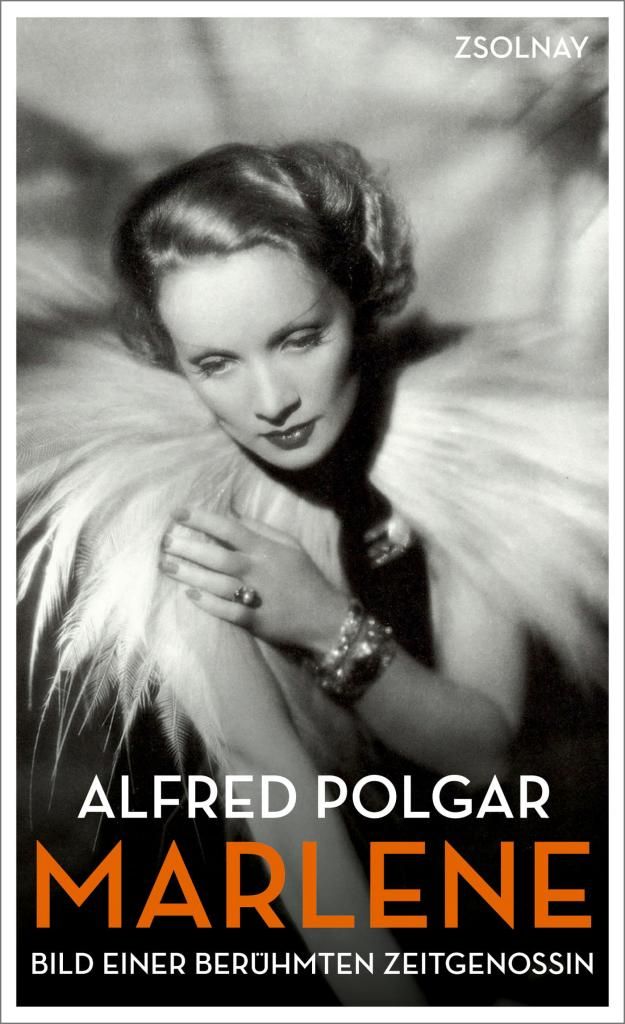
A Bilingual Review of Alfred Polgar's Marlene: Bild einer berühmten Zeitgenossin

Polgar, Alfred (2015). Marlene: Bild einer berühmten Zeitgenossin. Wien: Paul Zsolnay Verlag. [160 pages; € 17,90]

Blog reader Horst Zumkley has kindly contributed the following reviews in English and German of the latest Marlene Dietrich-related publication, Alfred Polgar's Marlene: Bild einer berühmten Zeitgenossin, edited and with an afterword by Ulrich Weinzierl, which is currently available at Amazon.de.

During the 1920s, Alfred Polgar (1873-1955) was a well-known Austrian critic and columnist who lived in Berlin. He later had to flee the Nazis and relied on the help of others also in exile. Through the mediation of a Swiss friend, Polgar received financial support from Marlene Dietrich. Sort of in return, Polgar agreed to write a portrait of her, which he composed during 1937 and 1938.

In 1984, Ulrich Weinzierl, who had edited Polgar's posthumously published works and written a biography about Polgar, found the biographical portrait in a suitcase in the New York apartment of Selma (Sally) Ell, the widow of Polgar's stepson Erik G. Ell. At that time, Weinzierl did not publish it because the circumstances under which the manuscript was written were still unclear.

Now, 60 years after Polgar’s death and nearly 80 years after its creation, Polgar’s manuscript finally appears in print as the first part of the book, Marlene: Bild einer berühmten Zeitgenossin. Polgar’s text traces the career of Marlene during the period between 1927 and 1937 and describes the "famous contemporary" as a quasi-god, gifted artist, and perfect human being

The second part of the book was written by Weinzierl, who retraces "the history" of this manuscript and contextualizes its emergence and meaning in Polgar's life as a Jewish emigrant.

This portrait of Marlene is more a book for Polgar fans than Dietrich admirers. The text, until now unknown, is pure hagiographical prose and brings nothing new; nevertheless, its belated publication is welcome.

Likely, Polgar played no special role for Marlene; he was one of many emigrants whom she helped. In Dietrich's autobiography, the name Polgar does not appear, and the manuscript, in which she participated, is not mentioned. Nor is the name Polgar mentioned in the Dietrich biographies by Maria Riva (Marlene's daughter), Bach, Freeman, Higham, Spoto, Walker, etc. Only in the biography by Werner Sudendorf (2001, p 124) is there is a mention of Polgar's support by Marlene and their cooperation in his book about her.

In contrast, Dietrich and the portrait that Polgar wrote about her were of particular importance for Polgar during his emigration period. This is convincingly pointed out by Weinzierl in his epilogue.

The best and most unique parts about this book are the subject, the previously unknown history of the origin of the manuscript, and its subsequent odyssey. It is a document of emigration history, interesting, sometimes grotesque, and certainly characteristic of that time.

--Horst Zumkley

Please read Zumkley's German-language review as well:

18 November 2014

Dietrich in London: 50th Anniversary

Half a century ago, this week, Marlene Dietrich arrived in London to prepare for a concert season in that city. She had previously performed there, at the Café de Paris in the fifties, but that was in cabaret. This would be London's first opportunity to experience her expanded repertoire, in a theatrical event finessed by musical director, Burt Bacharach, and herself.

Dietrich at Heathrow airport, November 1964.

03 June 2011

More on The Song of Songs DVD


In April, I mentioned the latest DVD release of The Song of Songs. Dave Kehr of The New York Times has written a comprehensive review of the DVD itself. Kehr asks a question that has also been on my mind, "Why this relatively minor effort when perhaps the most visually stunning of the Dietrich-Sternberg films, 'Shanghai Express' (1932), has never been released on DVD in this country [The United States]?"

25 May 2011

Joshua Sinclair, the knight in shining Charmin


Joshua Sinclair, the Just a Gigolo writer who told Charlotte Chandler the toilet paper typewriter (T.P.writer?) tale in her biography, Marlene: Marlene Dietrich, A Personal Biography, has apparently lavished Chandler with praise on Amazon.com. Well, his story is the best part of that book, which I mentioned in my reluctant spiel.

01 May 2011

Marlene Dietrich Movie Reviews on NYT Site

Marlene Dietrich movie reviews from the time of the films' release are appearing on The New York Times (NYT) website. Earlier, I cited the original NYT review of A Foreign Affair, but it appears that NYT is conducting an ongoing project to make all reviews available online. For those of you interested in the initial impact and media perception of these films, these reviews should serve you as informative sources.

Be aware that the NYT site is working out kinks, meaning that some of their links may currently be dead or some pages unlinked to their proper hubs. The NYT site could improve the search function by allowing users to limit their results to only reviews, trailers, etc., and if you agree, express this view to NYT here. So far, I have found original reviews for the following films:

Judgment at Nuremberg (1961)
No Highway in the Sky (1951)
Stage Fright (1950)
A Foreign Affair (1948)
Golden Earrings (1947)
Kismet (1944)
The Lady Is Willing (1942)
The Flame of New Orleans (1941)
Seven Sinners (1940)
Destry Rides Again (1939)
The Garden of Allah (1936)
The Devil Is a Woman (1935)
The Scarlet Empress (1934)
Blonde Venus (1932)
Shanghai Express (1932)
Dishonored (1931)
Morocco (1930)
The Blue Angel (1930) *Released in the United States after Morocco.
I Kiss Your Hand, Madame (1929) *Released in the United States in 1932.

Bosley Crowther appears to have been a decades-long admirer of Dietrich, no? Please share more review links in the comments section if you find them.

26 April 2011

Marlene Dietrich Got Top Nod For A Foreign Affair

Trailer screenshot via Wikimedia Commons
On July 1 1948, The New York Times reviewer Bosley Crowther praised A Foreign Affair, singling out Marlene Dietrich's Erika von Schlütow for doing "the most fascinating job" by embodying the film's "romantic allure" and "vagrant cynicism."

Dietrich, John Lund, and Billy Wilder later reteamed for the radio series, "Screen Director's Playhouse," which you can explore and download at Internet Archive. I will, however, embed Dietrich's reprisals below. Note that the first recording aired on March 6 1949, and the second broadcast on March 1 1951. Should I spoil the surprise for those who've never heard these shows? Yes! Rosalind Russell and Lucille Ball took on the role of Congresswoman Phoebe Frost in the 1949 and 1951 programs respectively! If either Lucy or Auntie Mame had shared motion picture credits with Dietrich, the boys surely would have burst in their theater seats like Fourth of July fireworks!